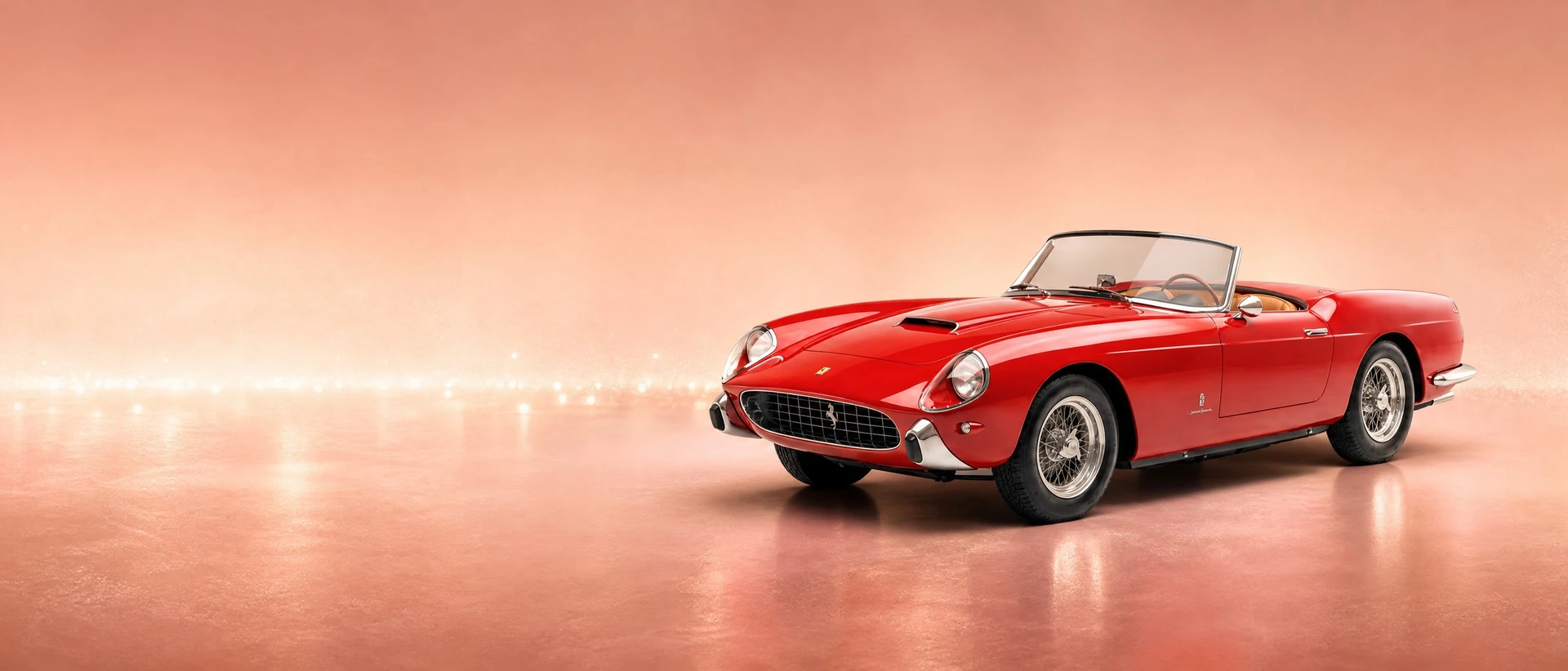
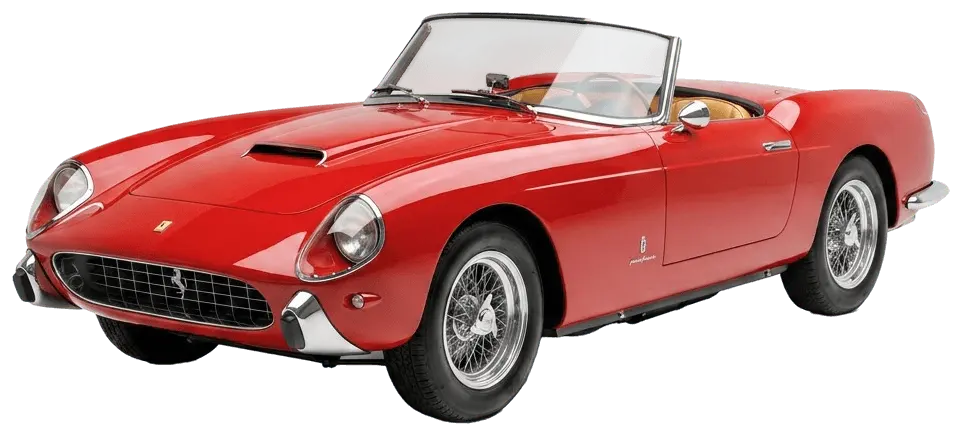
250 GT Cabriolet Pininfarina

The open grand tourer

The Pinin Farina Cabriolet was Ferrari's factory open grand tourer, distinct from the California Spider. Series I cars are scarce; roughly 200 Series II cars add disc brakes, overdrive and better touring manners.

Market value · road

$1.1M$7M

Typical $4.0M · 9 sales · +21% vs ’22–’23

$935K$7.4M
Open Market & Price

Market value · road

$1.1M$7M

Typical $4.0M · 9 sales · +21% vs ’22–’23

$935K$7.4M
’22’26
Market history · in the terminal
Open Market & Price
Engine
2'953 cc (Colombo V12 · outside-plug 128E/F on Series II)
Power
240 hp (factory metric figure — about 236 SAE)
Top speed
252 km/h (factory 1957 claim, no test named)
Gearbox
4-speed (Series II adds Laycock overdrive)
Built
40 + ~200 (two series, one nameplate)
Record
$6.83M (Series I · Monterey 2022)

Market & Price

The price and the proof

A terminal for one car: the model curve over the documented record, the benchmarks it is measured against, and the instruments that read it.

Records: 9 documented road sales on file · 2022–2026; estimate band $1.1M–$7M · good road cars. recorded sale prices · mixed hammer and premium-inclusive basis.

HCN:250GTCABLive model
$2'774'887101.9% · 12M
$1M$2M$5M20222023202420262027Rate shockS&P 500
Model curve · anchored to 8 documented salesnot investment advice
The readouts · model figures against the benchmarks8 documented anchors · last sale 3 mo ago

Compound annual growth

WindowThis car*S&P 500Gold
1Y+101.9%+18.8%+21.9%
5Y+19.1%+11.4%+17.6%

*Modeled price CAGR · S&P is a price index, no dividends

Deepest drawdown · model window

This car*-25.8%Aug 2022Oct 2022 · recovered Nov 2025
S&P 500-20.3%Dec 2021Oct 2022 · recovered Dec 2023
Gold-18.9%Feb 2026Jul 2026 · not recovered

Forecast ladder · model quantiles

HorizonP10P50P90
+6M$2.5M$2.9M$3.4M
+12M$2.4M$3.0M$3.8M
+24M$2.4M$3.3M$4.5M

Median path with the 10th and 90th percentile · not investment advice

Transaction ledger · documented sales

9 of 9 recorded sales · shown in USD · recorded currency in each record

Series identity is the first question, originality the second: matching drivetrain, Ferrari Classiche certification and the factory hardtop carry Series II value, while covered headlamps, fender vents and bumperettes define the Series I ceiling. Beware California Spider contamination in the comparables — same platform, different car, five to ten times the money.

Price range · road · openConfidence · lowThis is two markets under one nameplate. Series II is the liquid end — documented matching-numbers cars trade at $1.1–1.75 million at the premium houses. The forty Series I cars occupy $4.5–7.0 million, covered-headlamp cars on top, and can still fail against a $5.75-million reserve. The band spans both; read it with the series split, never as one curve.

Floor

$1.1M

Typical

$4.0M

Ceiling

$7M

Estimate band for good road cars. 9 documented sales since 2019 plotted below.

$902K$1.1M$4.0M$7M$7.6M
Hover the spectrum to read a value, or a dot for the sale behind it.

Band and axis shown in USD. Sale positions use indicative fixed-rate conversion to USD; sale readouts retain recorded currencies. Figures in USD for documented cars at premium houses, 2022–2026. Series II: $1.1–1.75M (Classic.com CMB $1.40M). Series I: $4.5–7.0M (CMB $5.48M; Hagerty's 2020 guide put #1 at $7.5M).

The wider market · Ferrari at auction · median per year · modeled between anchors2,297 lots · 2003–2026 · exact yearly anchors · modeled line

Instrument calibration for this file is in progress — the terminal above reads the documented record directly.

RM Sotheby's, Gooding and Bonhams figures include buyer's premium. Guide figures are date-stamped snapshots (Classic.com and The Classic Valuer, August 2026), not appraisals. Production prints as 40 + 200 (Massini standard); registers run 36–40 and 200–212 — never collapse the family to one total.

Overview

Ferrari's first series-built open car

The alliance behind the car was sealed in 1951, when Enzo Ferrari and Battista 'Pinin' Farina — neither willing to visit the other's city — met halfway and shook hands on a partnership the industry predicted would fail. By the mid-1950s Ferrari needed profitable road cars to fund the racing, and Pinin Farina got the brief for a proper open tourer: designed and built in Turin, not passed to Scaglietti. The prototype 0655GT entered the Pinin Farina plant in the last days of 1956 and stood at Geneva in March 1957.

The forty Series I cars — the first two effectively prototypes — came out of the coachbuilder's boutique shop with covered headlamps on the early cars and no two exactly alike. The Geneva car went to works driver Peter Collins, who fitted Dunlop discs in England; the factory took notice. At the Paris show on 1 October 1959 the redrawn Series II appeared — open lamps, upright screen, more cabin and boot, discs, overdrive and the outside-plug V12 — and production moved onto Pinin Farina's new Grugliasco line, where about 200 were built into mid-1962.

The 275 GTS took over the open-Ferrari brief in 1964, and memory of the Cabriolet was eclipsed by its glamorous sibling, the California Spider. The market has since re-read the family with precision: Series II cars trade as the accessible coachbuilt V12 Ferrari at $1.1–1.75 million, while the forty Series I cars — covered lamps at the top — occupy a market of their own, four times higher.

Body
Pinin Farina cabriolet, 2'600-mm LWB
Engine
3.0-litre Colombo V12
Series I
40 with the prototypes, 1957–59
Series II
about 200, 1959–62 — counts run 200–212
Successor
275 GTS, 1964

Reference

Technical specifications

Factory specification

Engine
Front longitudinal 60° V122'953.21 cc; Ferrari's 1957 archive specification. Series II moves to the outside-plug Tipo 128E, then 128F — twin distributors, coil valve springs
Power
240 hp at 7'000 rpmthe factory figure is metric — about 236 SAE; one RM catalog prints 232
Carburettors
Three Weber 36 DCL3Series II cars carry three Weber 40 DCL
Frame
Tubular steel, tipo 508508B/C, late Series I 508D — the stiffer frame shared with the late Tour de France
Dry weight
1'050 kgfactory archive figure — period kerb figures run to 1'296 kg

Series distinction

Series I
Boutique coachwork40 cars with the two prototypes, hand-built in Pinin Farina's custom shop; covered headlamps on early cars, no vent windows, no two exactly alike
Series II
Grugliasco series productionredrawn on the PF Coupé for Paris 1959 — open higher-set lamps, upright screen, more cabin and boot; about 200 built
Series II brakes
Four-wheel discsSeries I customer cars kept drums; only the Collins prototype wore Dunlop discs
Series II transmission
4-speed with overdriveLaycock de Normanville — not a five-speed, whatever the listings say

The records

0

Series I built

with the two prototypes · Massini census

0

Series II built

counts run 200–212 by register

0mm

Wheelbase

long-wheelbase throughout, both series

0$

Auction record

Series I 0963 GT · Monterey 2022

HICON BID

Buying interest, silently.

A HICON Bid is a confidential expression of buying interest on the Ferrari 250 GT Cabriolet Pininfarina file — never public, never shown to other members. It is not a binding purchase, and HICONIUM holds no funds.

Sign in

HICON Bids are a member instrument. Sign in to place one.

The vault

Open a file on yours.

You keep one? The record starts in your garage — identity, papers, photography, and the market evidence this file already carries, bound to your chassis.

The variants

One badge, 2 executions

The register separates the 250 GT Cabriolet Pininfarina into its documented executions. One reference silhouette per execution — each opens as its own file as the archive fills.

Ferrari 250 GT Cabriolet Pininfarina Series I — reference silhouetteSeries I01
Reference in preparationSeries II02

2 executions on file · references drawn to the house standard

The cars

The 250 GT Cabriolet Pininfarina register

Documented individual cars — chassis, colour, ownership and sale history. Open one for its full provenance. Public records only; members see the complete registry.

01 documented · public records

The hands

The people behind the car

The people whose work shaped the Ferrari 250 GT Cabriolet Pininfarina.
No free period portrait on record

Battista 'Pinin' Farina

Coachbuilder

The 1951 handshake with Enzo made his firm Ferrari's house stylist; the Cabriolet was unusual in being built, not just designed, in Turin. The firm and the family renamed themselves Pininfarina in 1961, mid-way through Series II.

No free period portrait on record

Sergio Pininfarina

Operational lead on Ferrari

Handed the Ferrari account by his father after the 1951 meeting — 'from A to Z. Design, engineering, technology, construction — the lot.' Period sources name him on the Series I styling; he later joined Ferrari's board.

No free period portrait on record

Enzo Ferrari

Principal

Commissioned the series cabriolet to fund the racing; adopted disc brakes for the Testa Rossa after trying them on Collins's car.

No free period portrait on record

Peter Collins

Works driver, first owner of 0655GT

Took the Geneva prototype to England and had Dunlop discs fitted — the first Ferrari so equipped. The car came back to Italy; the idea stayed.

No free period portrait on record

Luigi Chinetti

US importer

Fed Series II cars to America while separately pushing Maranello to build the car that would overshadow this one — the California Spider.