Manufacturers  /  Volkswagen

Volkswagen

Germany · est. 1937

From the People’s Car to a global volume marque

On the block
1 lots
Top value
Period
1937–
Volkswagen — manufacturer stage

Forthcoming lots

On the block · Monterey Car Week 2026

1 forthcoming lot · Monterey 2026

The house

From the People’s Car to a global volume marque

The German Labour Front established Gesellschaft zur Vorbereitung des Deutschen Volkswagens mbH in Berlin on 28 May 1937. It was renamed Volkswagenwerk GmbH on 16 September 1938. Ferdinand Porsche’s office had received the engineering-design commission from the Reich automotive industry association on 22 June 1934, after Porsche’s proposal for a light four-seat car with a 100 km/h cruising speed. Construction of the main plant east of Fallersleben began in 1938; its scale and manufacturing depth were modelled on Ford’s River Rouge plant.

At the May 1938 foundation-laying ceremony, Hitler named the car the KdF-Wagen. No civilian car had been produced when war began in September 1939; the plant was redirected to armaments and had built 66,285 vehicles by the end of the war. Volkswagen records that around 20,000 forced labourers, including prisoners of war and concentration-camp inmates, were compelled to work for the company.

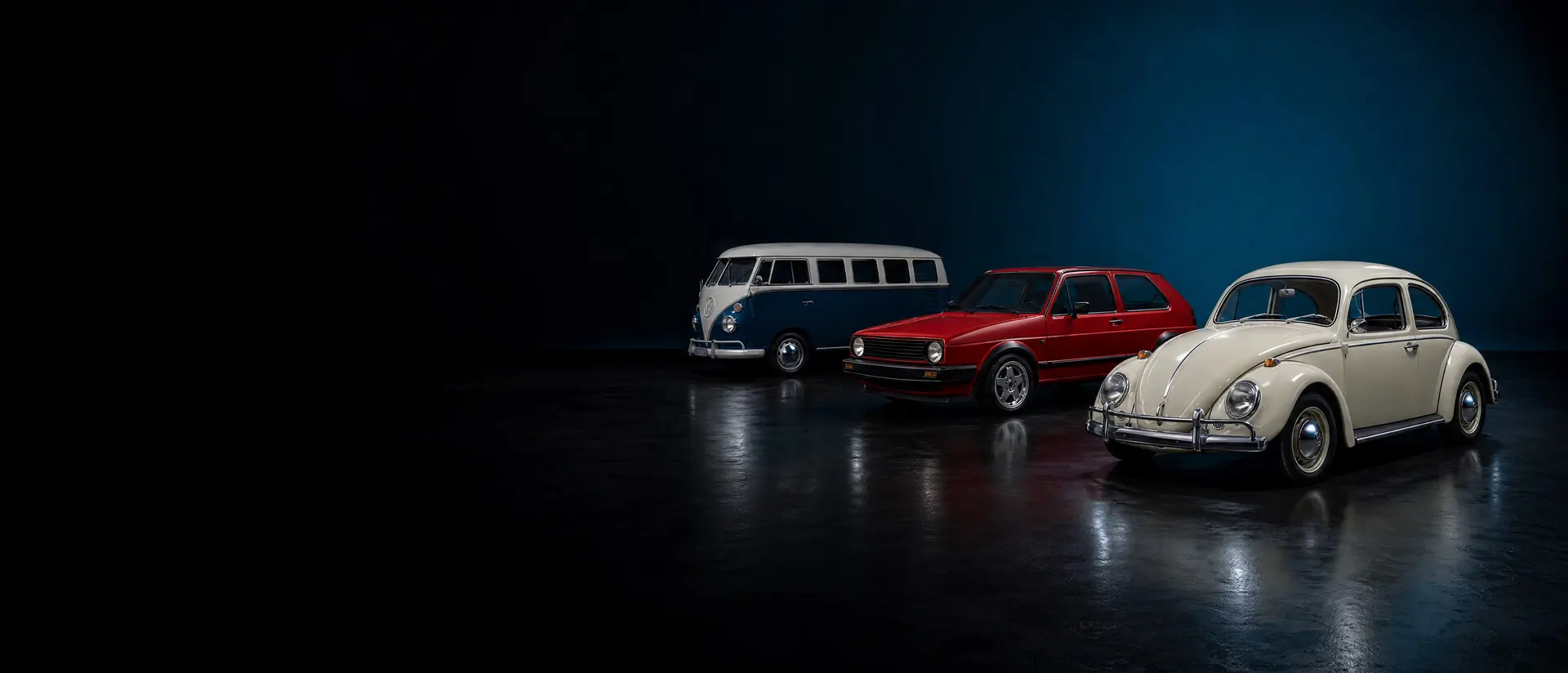
The British Military Government took Volkswagenwerk GmbH into trusteeship in June 1945. In August it ordered 20,000 saloons for occupation transport and appointed Major Ivan Hirst Senior Resident Officer; mass production of the Volkswagen saloon began on 27 December, with 55 completed by year-end. Heinrich Nordhoff became General Director on 1 January 1948. The Transporter entered mass production on 8 March 1950, using an air-cooled rear-mounted engine and other saloon technical features on a reinforced chassis.

On 17 February 1972, the 15,007,034th Beetle surpassed the Ford Model T production record. Wolfsburg built its last Beetle on 1 July 1974, while Puebla built the final Beetle on 30 July 2003; Volkswagen gives the total as 21,529,464 vehicles. The Passat, Scirocco and Golf established Volkswagen’s water-cooled front-wheel-drive generation in 1973–74. The Golf, designed by Italdesign under Giorgetto Giugiaro, entered production on 29 March 1974; Volkswagen reported more than 37 million Golfs built by March 2024.

Ferdinand Piëch became Chairman of Volkswagen AG’s Board of Management on 1 January 1993. In 1998, Volkswagen AG added Bentley, Lamborghini and Bugatti to the Group’s luxury portfolio; its official chronicle separately records Bentley’s brand acquisition, Lamborghini’s acquisition by Audi AG, and the acquisition of Bugatti brand rights. Phaeton production began in Dresden in December 2001. Volkswagen AG remains a publicly quoted company headquartered in Wolfsburg; as at 31 December 2025, Porsche Automobil Holding SE held 53.3% of voting rights, Lower Saxony 20.0%, and Quatar Holding 17.0%.

Founded
28 May 1937
The German Labour Front formed Gezuvor in Berlin; it became Volkswagenwerk GmbH on 16 September 1938.
Engineering brief
Ferdinand Porsche’s office
The Reich automotive industry association commissioned Porsche’s office for the people’s-car engineering design on 22 June 1934.
Type 1 output
21,529,464 vehicles
Volkswagen’s published total when the final Beetle left Puebla on 30 July 2003.
Golf output
More than 37 million
Volkswagen’s running total in March 2024, covering all Golf generations since series production began on 29 March 1974.
Voting rights
Porsche SE, 53.3%
As at 31 December 2025; Lower Saxony held 20.0% and Quatar Holding 17.0%.

Selected milestones

A bloodline, not a list.

  1. 1937

    The company is formed

    The German Labour Front establishes Gezuvor in Berlin on 28 May to plan and develop the people’s car. The company is renamed Volkswagenwerk GmbH on 16 September 1938.

  2. 1945

    Saloon production resumes

    The British Military Government takes the company into trusteeship in June. After ordering 20,000 saloons in August, mass production begins on 27 December; 55 vehicles are completed by year-end.

  3. 1960

    Privatisation and AG conversion

    On 21 July, the West German parliament approves the privatisation law. Sixty percent of the stock is sold as people’s shares, while the Federal Government and Lower Saxony retain 20% each. Volkswagenwerk AG is entered in the Wolfsburg register on 22 August.

  4. 1973–74

    The water-cooled generation

    The Passat, Scirocco and Golf establish Volkswagen’s water-cooled front-wheel-drive model generation. Golf production begins in Wolfsburg on 29 March 1974; the last Wolfsburg Beetle leaves the line on 1 July.

  5. 1993–2001

    A broader group and the Phaeton

    Ferdinand Piëch becomes Chairman of Volkswagen AG’s Board of Management on 1 January 1993. In 1998 the Group expands its luxury portfolio; Phaeton production begins in Dresden in December 2001.

What defines Volkswagen

Evolve a durable mechanical idea

The Beetle’s air-cooled rear-engine formula was developed incrementally for decades. The Type 2 added a second model line in 1950, sharing some technical features and the rear-mounted air-cooled engine but using a reinforced chassis.

Change the volume-car architecture

As Beetle sales lost momentum after 1970, Volkswagen introduced water-cooled front-wheel-drive models: Passat in 1973, then Scirocco and Golf in 1974. This transition coexisted with continuing Beetle development, including the 1303’s major 1972 overhaul.

Expand at Group level

Volkswagen AG broadened its multi-brand portfolio in 1998 with Bentley, Lamborghini and Bugatti. The Volkswagen marque entered the luxury-saloon segment with the Phaeton, whose Dresden production began in December 2001.