One man's engineering
Lotec cars are the work of a single builder's judgement — designed, engineered and assembled in one Bavarian workshop.
Kolbermoor, Germany · est. 1962
Lotec built race winners for decades; then one man built one hypercar.

Curated entry points
Three cars that explain the manufacturer: its origins, its engineering peak and the shape of its modern ambition.
Complete catalogue
1 models · 1 families
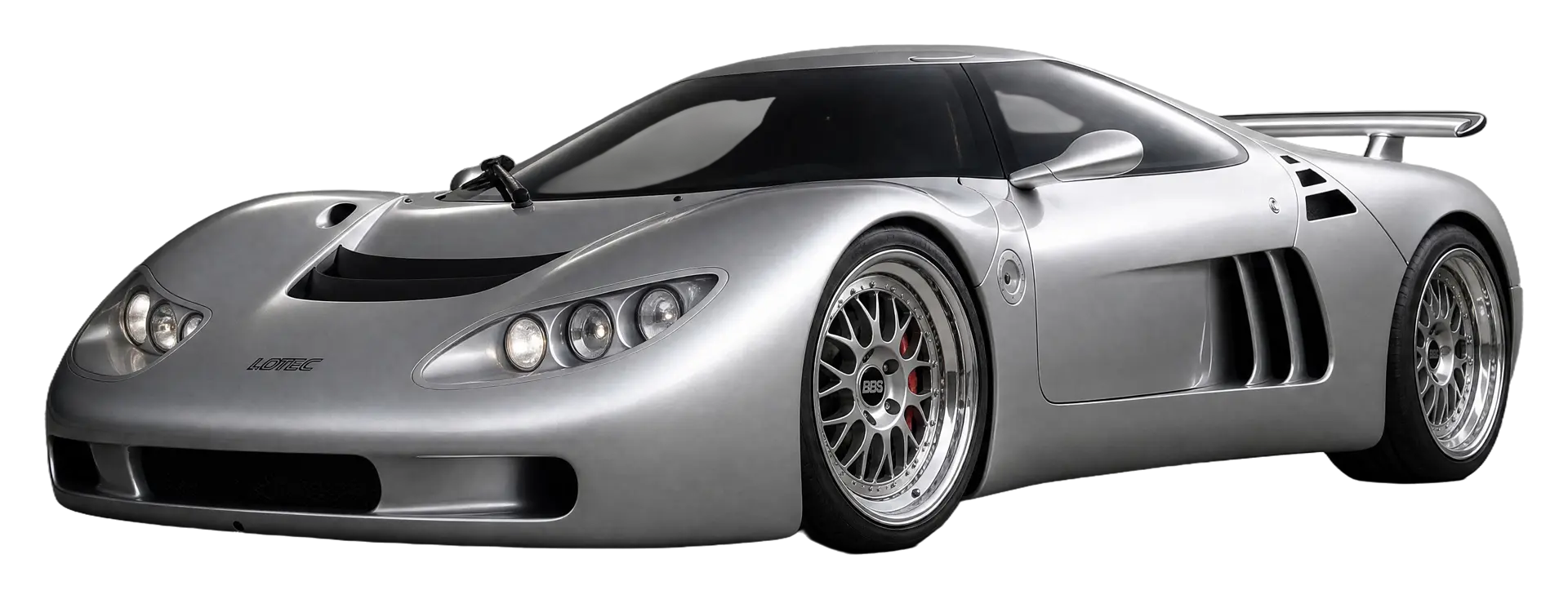
Eight years of hand-building for one car: Kurt Lotterschmid’s twin-turbo V12 hypercar, aimed past 400 km/h and never repeated.
The house
Kurt Lotterschmid opened his workshop in Kolbermoor in 1962 and went racing: Formula Vee wins from 1969, outright Interserie titles in 1979 and 1980, a German C2 sportscar championship in 1983. Tuning paid the bills — TÜV-approved turbo conversions for Mercedes and Ferrari that made Lotec the quiet address for absurd horsepower.
The one-offs made the name. The Colani-drawn Testa d’Oro took a catalysed Ferrari to 342 km/h at Bonneville in 1991, and in 1995 Lotec delivered the C1000 — a carbon one-off commissioned from Dubai for more than $3.4 million, then among the most expensive cars ever built to order.
The Sirius, finished in 2000, was Lotterschmid’s own statement: a twin-turbo Mercedes V12 aimed at 400 km/h, built exactly once. Today the cars run again under the Lotec Legacy banner — Goodwood in 2026, and the story quietly reopened.
Selected milestones
1962
The workshop opens
Kurt Lotterschmid founds Lotec in Kolbermoor and begins racing and tuning.
1979
Interserie champion
First of two consecutive outright Interserie titles; the German C2 championship follows in 1983.
1991
Bonneville
The Colani-designed Testa d'Oro on Ferrari basis records 342 km/h — the world record for catalyst-equipped cars.
1995
The C1000
Delivery of the carbon-bodied C1000, commissioned from Dubai at more than $3.4 million.
2000
The Sirius
Lotterschmid's own 400 km/h project debuts in Geneva after an eight-year build.
2026
Lotec Legacy
The revived brand campaigns the cars publicly again — Ultrace, then the first Lotec appearance at the Goodwood Festival of Speed.
What defines Lotec
Lotec cars are the work of a single builder's judgement — designed, engineered and assembled in one Bavarian workshop.
Two decades of race wins funded and informed everything the shop later built for the road.
Every attempt at production collapsed; what remains are single cars, which is precisely their value.