A transverse V16
The 5,995 cc engine used a single aluminium block, four heads and two crankshafts geared to a central output feeding a longitudinal ZF five-speed transaxle. It was mounted transversely behind the cabin.
Italy · est. 1988
Cizeta’s transverse V16, from Modena to Los Angeles.
Forthcoming lots
1 forthcoming lot · Monterey 2026
The house
Cizeta grew from Claudio Zampolli's ambition to build a car under his own initials. A former Lamborghini test and development engineer, Zampolli had established an exotic-car business in Los Angeles when he partnered with Giorgio Moroder, then a 50 per cent investor in the enterprise; the concern was reported first as Cizeta Motors and then as Cizeta Moroder Motors.
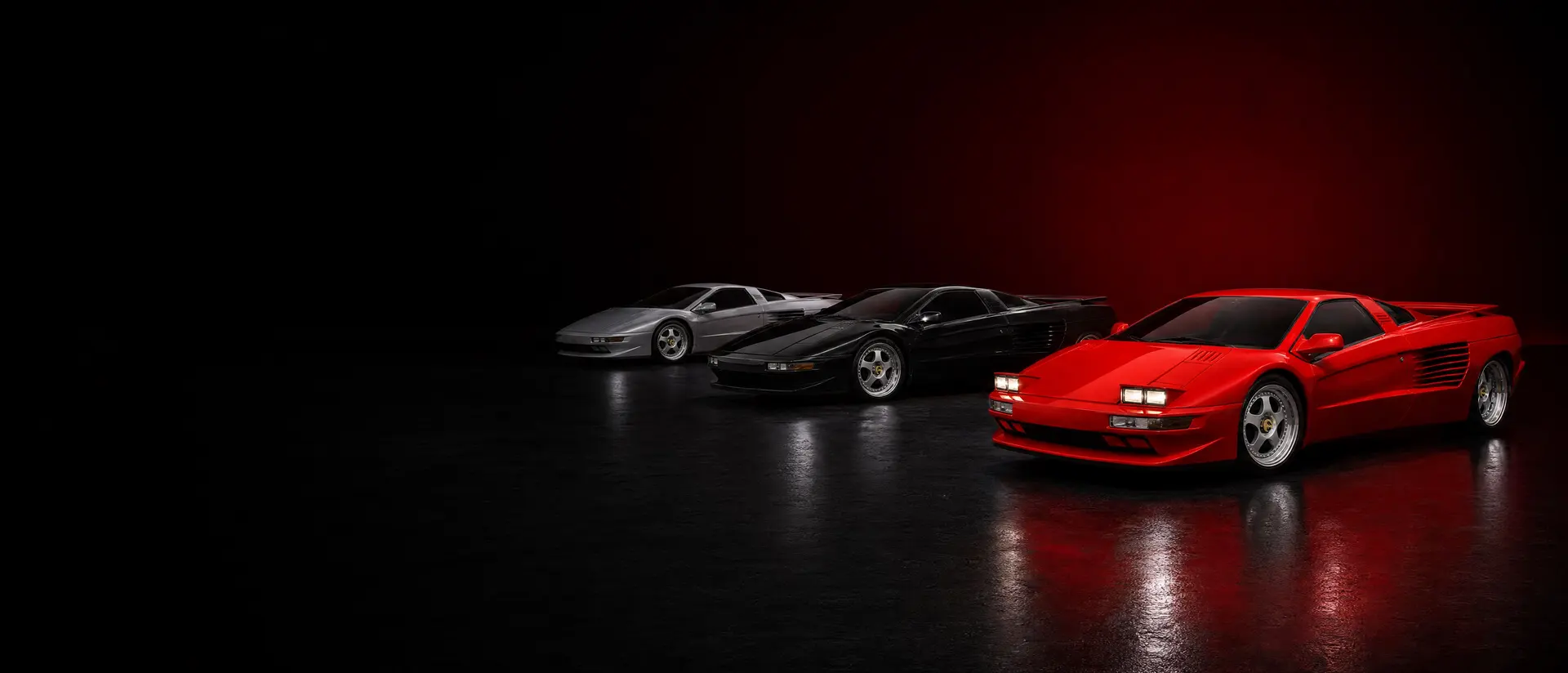
Its sole model was the mid-engined V16T. Contemporary road tests described a 5,995 cc transverse V16 with one aluminium block, four cylinder heads, two crankshafts geared to a central output and a longitudinal ZF five-speed transaxle; the chassis was a tubular spaceframe. Oliviero Pedrazzi led engine development, Giancarlo Guerra was engaged for the first-run cars, and Marcello Gandini designed the body.
Chassis 001 was unveiled in Los Angeles on 5 December 1988. It was the only car badged Cizeta-Moroder; after Moroder and Zampolli parted following the prototype, customer cars used the Cizeta V16T name. The relationship between the Cizeta's Gandini design, the P132 study and the later Lamborghini Diablo is real but not settled tightly enough to call the Cizeta a Diablo prototype.
Autoweek reports that the Italian company was in bankruptcy by 1994. Sources record later California completions, including the 2003 Fenice TTJ Spyder, but disagree sharply over the total number of cars. The historical Cizeta-Moroder entity is defunct; later projects claiming the Cizeta name are not treated here as its continuation.
Selected milestones
1988
Los Angeles debut
RM Sotheby's identifies chassis 001 as the original prototype and show car, unveiled in Los Angeles on 5 December 1988. Contemporary CAR reporting describes the car then on display as a running prototype.
1988–90
Moroder exits
The partnership ended after the prototype, with Moroder retaining chassis 001. Subsequent customer cars used the Cizeta V16T badge rather than Cizeta-Moroder.
1991
Customer-car production reported
A period account republished by Cizeta USA says the first production car appeared at Geneva in 1991, with full production beginning later that year.
1994
Italian bankruptcy
Autoweek reports that Cizeta Automobili was in bankruptcy by 1994; later accounts report that remaining components were taken to California.
2003
Fenice TTJ Spyder
The one-off Fenice TTJ Spyder is documented as a 2003 Cizeta V16T derivative unveiled at Concorso Italiano in Monterey.
What defines Cizeta Moroder
The 5,995 cc engine used a single aluminium block, four heads and two crankshafts geared to a central output feeding a longitudinal ZF five-speed transaxle. It was mounted transversely behind the cabin.
Marcello Gandini designed the Cizeta body. A Gandini Countach-successor study and the Cizeta–Diablo resemblance are documented, but the exact derivation of the production Cizeta from Lamborghini's P132 programme remains disputed.
The V16T paired an aluminium body with a tubular spaceframe. The later split between Moroder and Zampolli was reported to involve Moroder's proposal for fibreglass bodywork and a BMW production engine.