Industrial luxury
The East Grand Boulevard works developed from brick-and-timber shops into a reinforced-concrete factory complex. Packard nevertheless continued to offer factory bodywork and custom-body options for some senior cars.
USA · est. 1899
The American luxury marque that brought the V12 into volume automobile production
Forthcoming lots
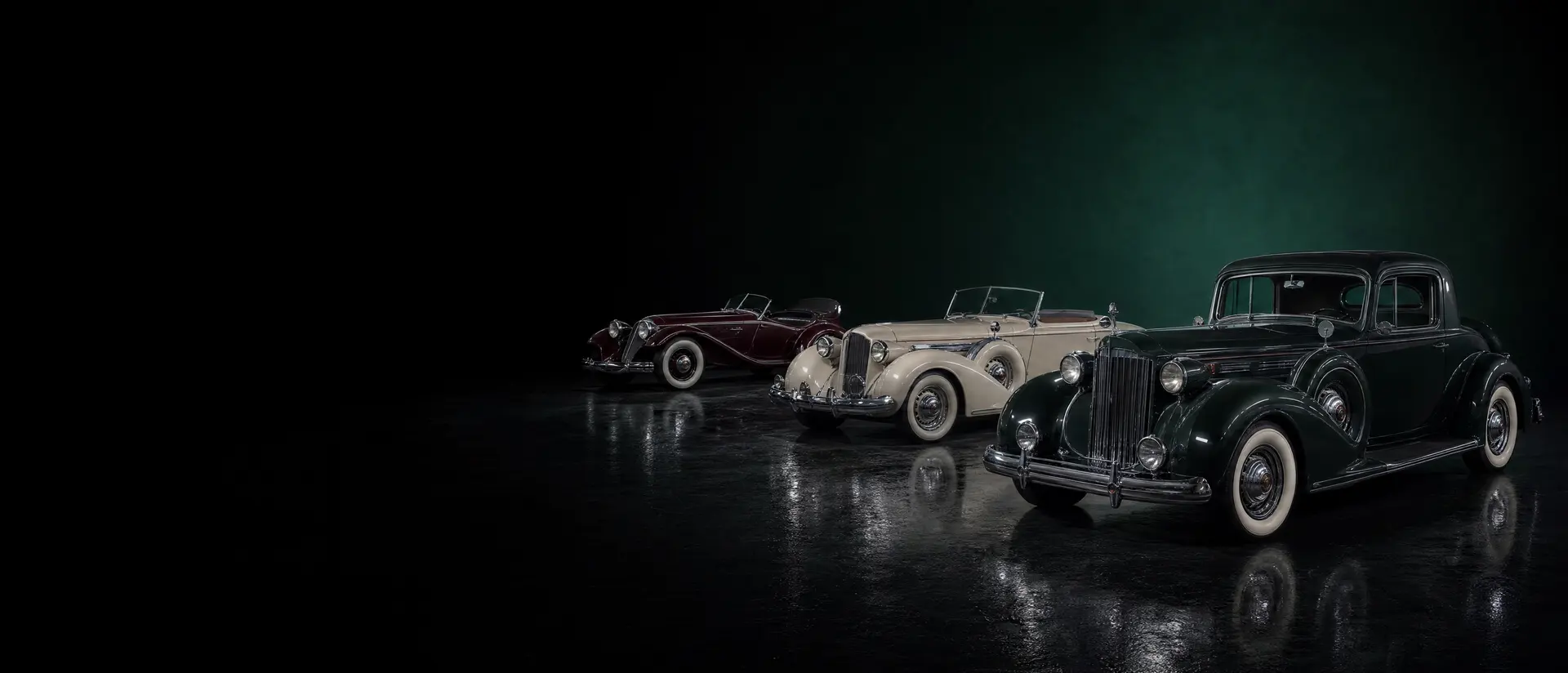
3 forthcoming lots · Monterey 2026
The house
James Ward and William Doud Packard built their first automobile in Warren, Ohio, in 1899. Packard Club reference data identifies it as the single-cylinder Model A, introduced on 6 November 1899, and records one built that year. The Packard-Weiss enterprise incorporated as the Ohio Automobile Company in 1900, with George Lewis Weiss as vice-president; in October 1902 Henry B. Joy's Detroit group subscribed $150,000 of a $250,000 stock offering as the business became the Packard Motor Car Company. The move to Detroit was completed in October 1903.
The first East Grand Boulevard complex was built in 1903 as brick-and-timber buildings designed by Albert and Julius Kahn. Building No. 10, added in 1906, used reinforced concrete. Packard's Model C brought a steering wheel in 1900. In May 1915, chief engineer Jesse Vincent's 424-cubic-inch Twin Six entered production as a 1916 model; contemporary histories identify it as the first V12 in volume automobile production. A published model history reports 35,102 Twin Sixes sold before the line ended in June 1923.
The lower-priced One Twenty entered the range in 1935 and helped move Packard into the medium-priced field. It contributed to the company's 1937 peak of 109,518 cars. During the Second World War, Packard built Rolls-Royce Merlin engines under licence: the National Museum of the United States Air Force records 54,714 Packard-built engines within the 55,511 made in the United States for the Army Air Forces.
Packard and Studebaker formally merged in October 1954. Car assembly left East Grand Boulevard after the 1954 model year for Conner Avenue; the final true Packard left Detroit on 25 June 1956. Studebaker-based Packards then came from South Bend for 1957 and 1958: 4,809 in 1957 and 2,622 in 1958, with manufacture ending in July 1958. The original manufacturer is defunct. A separate modern business uses the Packard name for merchandise and has described a future Packard Victoria programme; it is a revival, not a continuation of the original company.
Selected milestones
1899
Model A introduced in Warren
Packard Club reference data dates the one-cylinder Model A to 6 November 1899 and records one produced that year.
1902–03
New name, Detroit move
The Ohio Automobile Company became the Packard Motor Car Company in October 1902. Joy's Detroit investors gained control, and the move to Detroit was completed in October 1903.
1915
Twin Six enters production
Introduced in May as a 1916 model, Jesse Vincent's 424-cubic-inch V12 was the first V12 in volume automobile production. The line continued through June 1923.
1935
One Twenty expands the range
Packard introduced the One Twenty in the medium-priced eight-cylinder market. Company production reached a record 109,518 cars in 1937.
1954–58
Assembly moves and the marque ends
East Grand Boulevard car assembly ended after 1954, and the final true Packard left Detroit on 25 June 1956. South Bend then built Studebaker-based Packards through July 1958.
What defines Packard
The East Grand Boulevard works developed from brick-and-timber shops into a reinforced-concrete factory complex. Packard nevertheless continued to offer factory bodywork and custom-body options for some senior cars.
“Ask the Man Who Owns One” became Packard's enduring advertising signature, making existing owners part of the sales argument.
The 1935 One Twenty carried Packard into the medium-priced eight-cylinder market. It broadened the range while senior Packards remained available.