Front-wheel-drive packaging
Both Cord series drove their front wheels. The L-29 adapted Miller-derived engineering, while the 810/812 placed a Lycoming V8 behind a forward-mounted, electrically actuated four-speed transmission.
USA · est. 1929
The front-drive marque of the Auburn-Cord-Duesenberg group.
Forthcoming lots
1 forthcoming lot · Monterey 2026
The house
Errett Lobban Cord introduced the Cord marque in 1929 with the L-29. The cars were manufactured by the Auburn Automobile Company; the Cord Corporation was announced on 15 June 1929 as a holding and operating company for Cord's transport interests. The L-29 was assembled at Auburn, Indiana, and was the first front-wheel-drive automobile sold in the American market.
Auburn had acquired Harry Miller's front-drive patent and manufacturing rights, with Cornelius W. Van Ranst taking the Miller-based system into production. The L-29's front-drive layout enabled a low, long-bodied car; Alan H. Leamy styled it. Its 125 hp Lycoming straight-eight drove a three-speed transmission ahead of the engine, and the range comprised sedan, brougham, convertible coupé and phaeton-sedan bodies.
The Depression damaged demand. L-29 assembly ceased on 31 December 1931; the final cars were sold as 1932 models, but no L-29s were built in 1932. Auburn's Auburn factory operations closed after 1933, while the later Cord 810 and 812 were produced at Connersville.
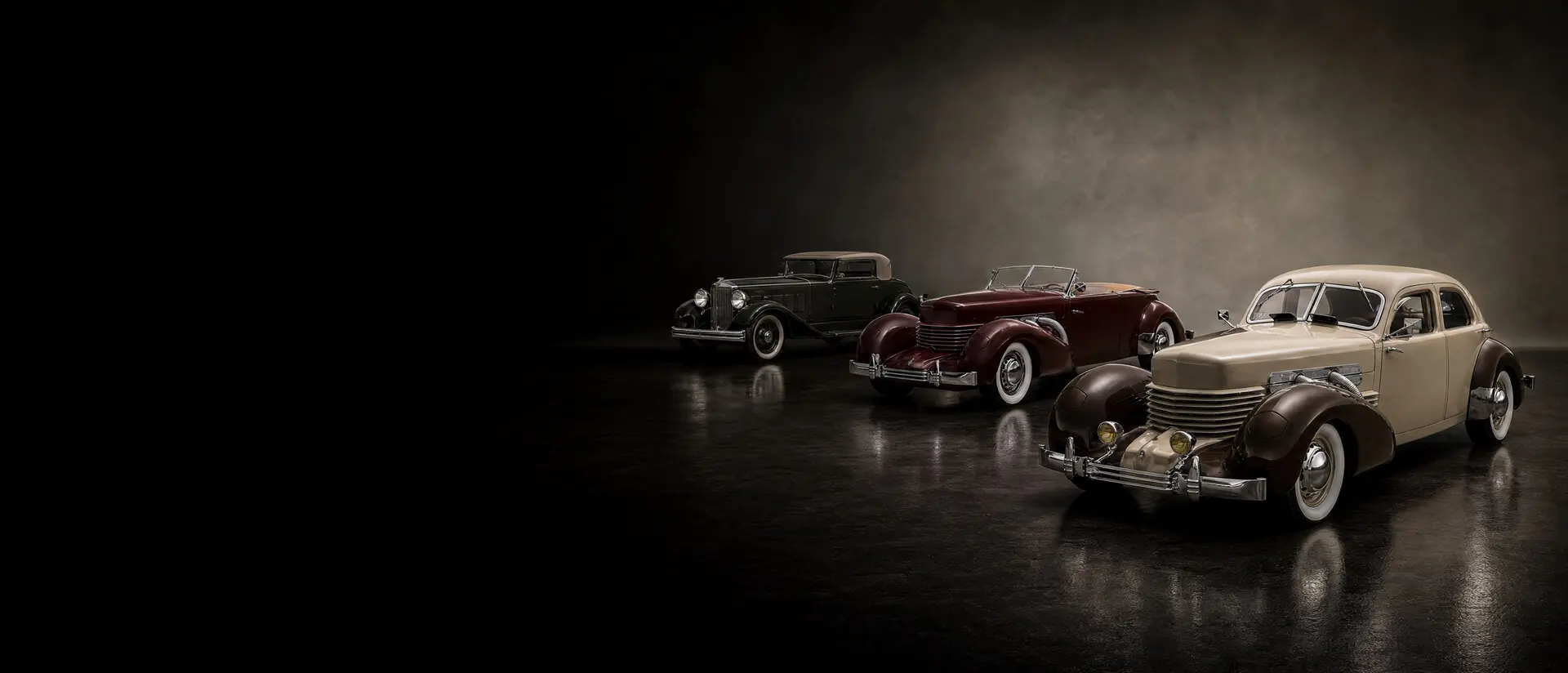
Gordon M. Buehrig styled the 810, shown at the 1935 New York Auto Show. Its Lycoming V8, front-wheel drive and four-speed Bendix electric pre-selector accompanied concealed headlamps, a wraparound louvered nose and no running boards. Christmas delivery promises were missed; 1,174 810s were sold in 1936. The 1937 812 offered a Schwitzer-Cummins supercharger, identified externally by chrome side exhausts.
Reliability problems, including transmission faults and vapour lock, coincided with a declining dealer network. The last 812 was assembled during the week of 21 August 1937; Auburn's automotive operation closed that November and the Auburn Automobile Company filed for bankruptcy on 11 December. Contemporary accounts generally place 810/812 production at about 3,000 cars; this is a build total, not a survival figure.
Later ownership of assets and trademarks did not continue the original company. Dallas E. Winslow bought remaining Auburn and Cord parts and tooling in 1938, and Glenn Pray later made scaled, Corvair-powered Cord 8/10 replicas. Craig Corbell's later revival proposal produced no cars; the Cord trademarks sold at auction in 2023 for $31,000.
MoMA's Eight Automobiles exhibition ran from 28 August to 11 November 1951 and included a loaned 1937 Cord. The museum's press material described its pontoon fenders and coffin-shaped hood.
Selected milestones
1929
L-29 enters production
Auburn assembled the L-29 in Indiana, bringing Miller-derived front-wheel-drive engineering to the American market.
1931
L-29 assembly ceases
Assembly ended on 31 December 1931. Final inventory was sold as 1932 models, rather than built in a 1932 run.
1935
810 shown in New York
Buehrig's 810 brought a Lycoming V8, front-wheel drive, hidden headlamps and its louvered coffin-nose treatment to the New York Auto Show.
1937
Cord production ends
The final 812 was assembled during the week of 21 August; Auburn's automotive operation subsequently closed and the company filed for bankruptcy in December.
1951
A Cord at MoMA
MoMA's Eight Automobiles exhibition included a loaned 1937 Cord and ran from 28 August to 11 November.
What defines Cord
Both Cord series drove their front wheels. The L-29 adapted Miller-derived engineering, while the 810/812 placed a Lycoming V8 behind a forward-mounted, electrically actuated four-speed transmission.
The 810/812 used concealed headlamps and door hinges, a covered fuel filler, a rear-hinged hood and a wraparound louvered nose in place of a conventional upright grille.