Engineering-led development
Chrysler's early reputation rested on the Six's high-compression engine and hydraulic brakes, while the Airflow applied aerodynamic research to its mechanical layout.
USA · est. 1925
A Detroit marque shaped by engineering experiments and the 300 series.
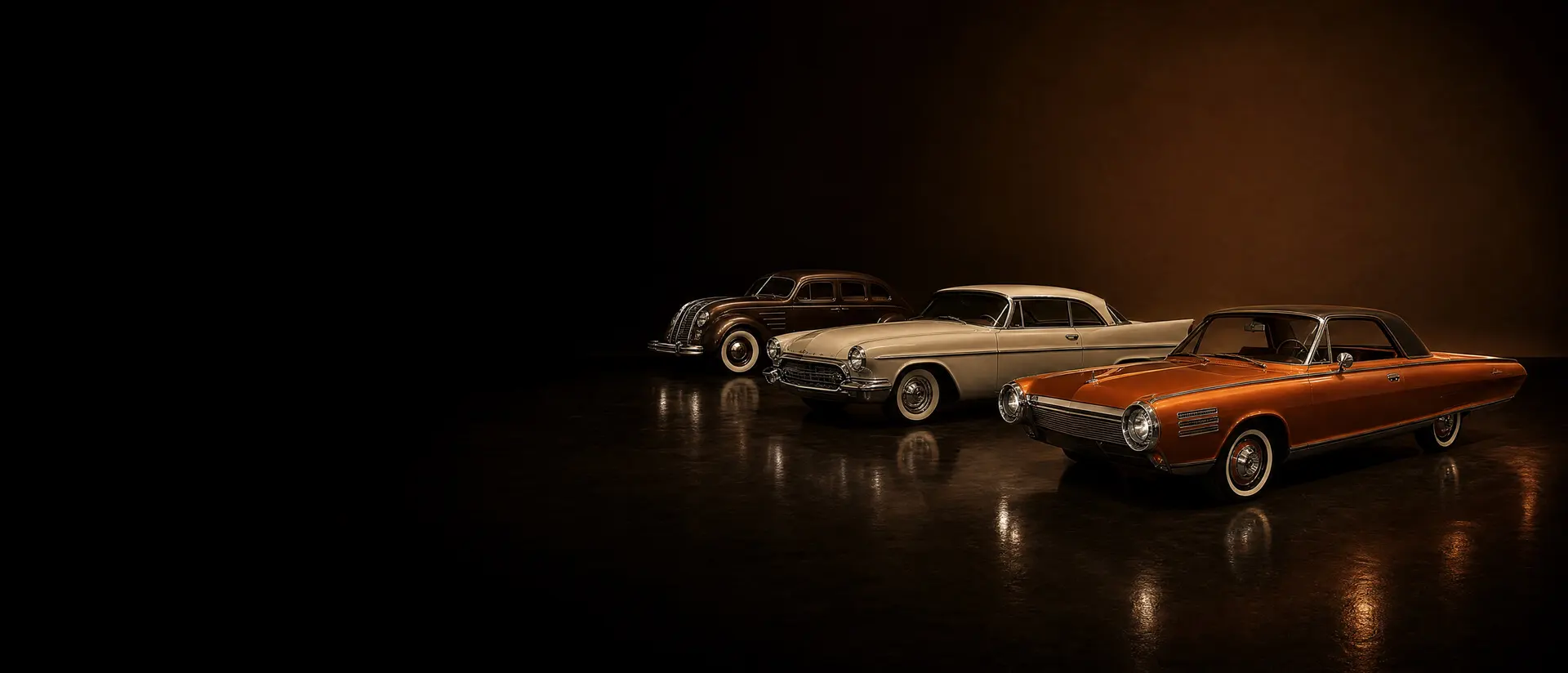
Forthcoming lots
1 forthcoming lot · Monterey 2026
The house
Walter P. Chrysler reorganised the ailing Maxwell Motor Corporation as the Chrysler Corporation on 6 June 1925, after the first Chrysler Six had been introduced in 1924. Fred Zeder, Owen Skelton and Carl Breer designed that Six for Maxwell; its high-compression engine and four-wheel hydraulic brakes established Chrysler's engineering-led identity. In 1928 Chrysler formed Plymouth and DeSoto and merged with Dodge Brothers.
In the late 1920s, Carl Breer's team worked with Orville Wright on a small wind tunnel; the testing continued through 1931. The 1934 Airflow placed its engine over the front axle and moved rear-seat passengers forward of the rear axle. Sales were weak, and the Airflow Club gives a combined Chrysler-and-DeSoto output of about 55,000 cars.
Chrysler introduced its 331-cubic-inch FirePower overhead-valve V8 in 1951, rated at 180 horsepower and using hemispherical combustion chambers. Virgil Exner joined Chrysler from Studebaker in 1949, and Ghia built Chrysler concept cars around production mechanicals: the K-310 was fully functional on a New Yorker chassis, while the d'Elegance used a shortened New Yorker chassis and FirePower V8. The Thomas Special was a distinct car for Chrysler export chief C.B. Thomas; related Chrysler Specials and GS-1s later reached a limited European clientele.
The 1955 C-300 used a 331-cubic-inch Hemi V8 with dual four-barrel carburettors, solid lifters and a 300-horsepower rating. The Chrysler 300 Club records 1,725 units for the short 1955 model year. Tim Flock won the 1955 NASCAR premier-series championship in Carl Kiekhaefer's Chrysler, with 18 victories in 39 races; the original 300 letter series ended with the 300L in 1965, and the 413-cubic-inch wedge V8 replaced the Hemi for the 1959 300E.
Chrysler passed through DaimlerChrysler, Cerberus ownership, its 30 April 2009 Chapter 11 reorganisation and Fiat ownership before becoming part of FCA. FCA's merger with Groupe PSA completed on 16 January 2021, creating Stellantis. Chrysler remains a Stellantis brand; 300 production ended at Brampton in December 2023, while Chrysler's current site lists the Pacifica and Voyager.
Selected milestones
1924
The Chrysler Six appears
Zeder, Skelton and Breer designed the first Chrysler for Maxwell. It combined a high-compression six-cylinder engine with four-wheel hydraulic brakes.
1925
The corporation is formed
Maxwell was reorganised as the Chrysler Corporation on 6 June, with Walter P. Chrysler as chairman and president.
1934
The Airflow enters production
Wind-tunnel work informed an architecture with the engine over the front axle and the passenger compartment moved forward. The design sold poorly; the Airflow Club estimates about 55,000 Chrysler and DeSoto Airflows in total.
1951
FirePower V8 introduced
Chrysler's 331-cubic-inch overhead-valve FirePower V8 used hemispherical combustion chambers and was rated at 180 horsepower.
1955
The C-300 and NASCAR
The C-300 went on sale on 10 February with 300 horsepower. Tim Flock won the NASCAR premier-series championship in Carl Kiekhaefer's Chrysler, taking 18 victories in 39 races.
2021
Stellantis is created
FCA and Groupe PSA completed their merger on 16 January. Chrysler remains one of Stellantis's active brands; the final Chrysler 300 production ended in December 2023.
What defines Chrysler
Chrysler's early reputation rested on the Six's high-compression engine and hydraulic brakes, while the Airflow applied aerodynamic research to its mechanical layout.
The 1951 FirePower V8 paired an overhead-valve layout with hemispherical combustion chambers. The C-300 later developed the 331-cubic-inch engine with dual four-barrel carburettors, solid lifters and a 300-horsepower rating.
Exner's collaboration with Ghia produced functioning, production-based concepts including the K-310 and d'Elegance. Related Chrysler Specials and GS-1s, rather than the one Thomas Special, later reached a small European market.