Factory RUF and converted Porsche are distinct
A factory-built RUF starts from a bare Porsche shell or, in later cases, RUF's own structure and carries a RUF chassis number. A customer Porsche converted by RUF retains its Porsche identity.
Pfaffenhausen, Germany · est. 1939
A RUF, not merely a modified Porsche.
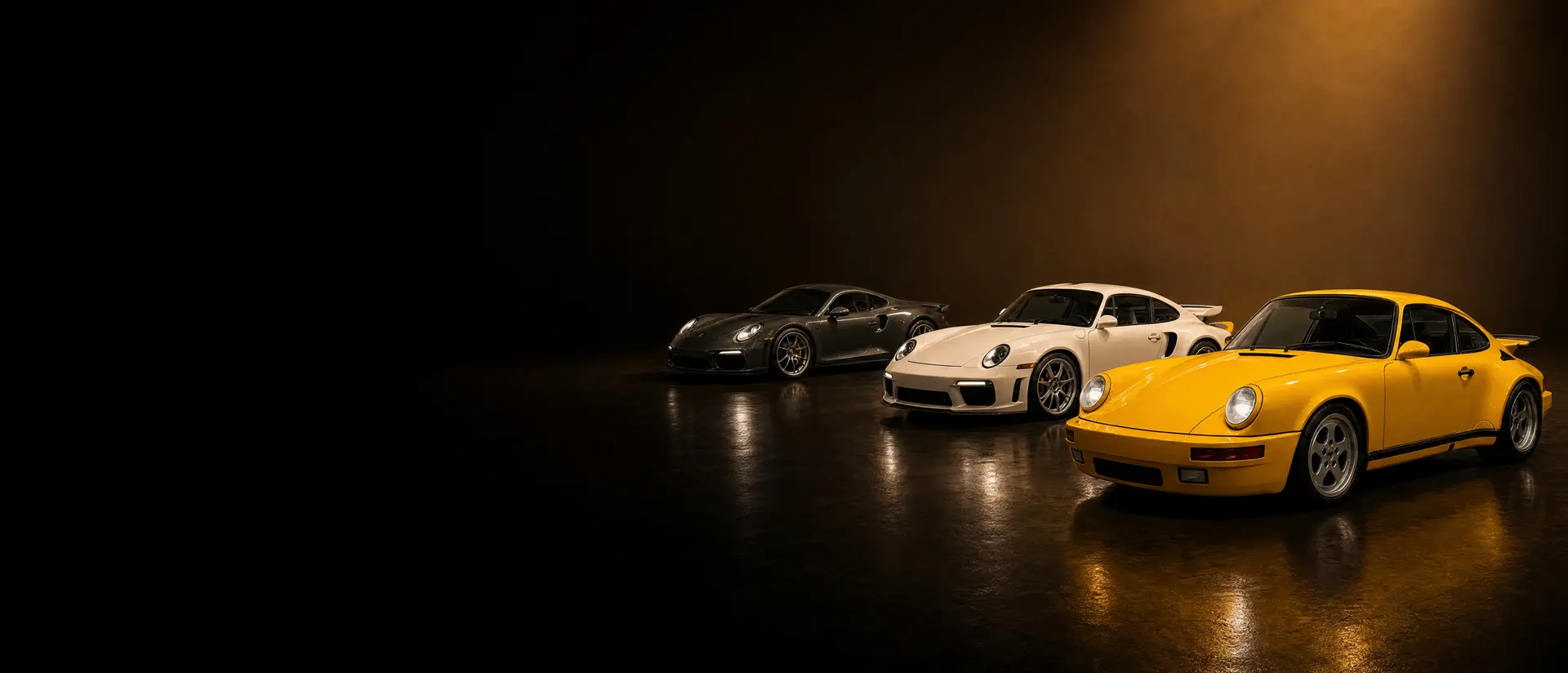
Forthcoming lots
6 forthcoming lots · Monterey 2026
The house
Alois Ruf Sr. founded AUTO RUF as a general service garage in Pfaffenhausen in 1939. The business added a filling station in 1949; in 1955 Ruf Sr. built a tourist bus and operated that work separately. In 1963, he repaired a damaged Porsche 356, after which the company began specialising in Porsche vehicles. Alois Ruf Jr., born in 1950 in the house next to the workshop, grew up in the business.
After Ruf Sr.'s death in 1974, Alois Ruf Jr. took charge at twenty-four. The first RUF-enhanced Porsche followed in 1975. Porsche's 930 Turbo had a four-speed transmission; RUF developed its own five-speed alternative. In 1981, the Kraftfahrt-Bundesamt recognised RUF as a vehicle manufacturer, and Alois Ruf says the company has used its own chassis numbers since then.
The 1983 BTR was the first RUF model with its own VIN. A BTR reached 186.2 mph in Road & Track's 1984 World's Fastest Cars test. In 1987, the 469 PS twin-turbo CTR recorded 339.8 km/h at Volkswagen's Ehra-Lessien test track in Road & Track's test, with Phil Hill driving the fastest run; the magazine's photographers gave the yellow car its Yellowbird nickname. Sources support 29 factory-built original CTRs, made from Porsche-supplied bare Carrera 3.2 shells between 1987 and 1996; customer-car conversions retained Porsche identities and are excluded from that count.
RUF later developed the 993-based CTR2 and the mid-engined CTR3 with Multimatic. At Geneva in 2017, RUF introduced the CTR Anniversary, its first automobile conceived and manufactured by RUF, with a carbon-fibre monocoque of its own design. The contemporary company trades as RUF Automobile GmbH at Mindelheimer Straße 21, Pfaffenhausen; its legal notice names Alois Ruf and Estonia Ruf as owners and managing directors.
Selected milestones
1939
AUTO RUF begins
Alois Ruf Sr. opens a general service garage in Pfaffenhausen. A filling station follows in 1949, and a separately operated tourist-bus business follows the construction of Ruf Sr.'s own bus in 1955.
1974
Alois Ruf Jr. takes charge
After his father's death, twenty-four-year-old Alois Ruf Jr. assumes leadership. The first RUF-enhanced Porsche appears in 1975.
1981
Manufacturer recognition
The Kraftfahrt-Bundesamt recognises RUF as a vehicle manufacturer. RUF develops its own five-speed transmission where Porsche's 930 Turbo had four speeds.
1987
CTR sets the test pace
In Road & Track's Ehra-Lessien test, Phil Hill records 339.8 km/h in the 469 PS CTR. The magazine's photographers give the yellow test car its Yellowbird nickname.
2017
CTR Anniversary carbon monocoque
RUF presents its first automobile conceived and manufactured by the company, built around a RUF-developed carbon-fibre monocoque. The initial 30-car plan excluding the prototype was later raised to a planned 50; neither is a completed-production total.
What defines RUF
A factory-built RUF starts from a bare Porsche shell or, in later cases, RUF's own structure and carries a RUF chassis number. A customer Porsche converted by RUF retains its Porsche identity.
RUF developed a five-speed transmission when Porsche offered the 930 Turbo with four speeds. The CTR then paired a lightened Carrera 3.2 shell with a 3.4-litre twin-turbo flat-six.
The CTR Anniversary uses a RUF-developed carbon-fibre monocoque, rear-mounted twin-turbo flat-six, and manual gearbox. That specification should not be generalised to every current RUF: the CTR3 Evo has a steel chassis, carbon-composite body shell, and dual-clutch transmission.