Integrated manufacture
The Yokohama Plant was designed to incorporate vehicle production from parts manufacture to final assembly, and produced its first fully integrated-assembly car in 1935.
Yokohama, Japan · est. 1933
Japan’s mass-market major, collector-defined by the GT-R
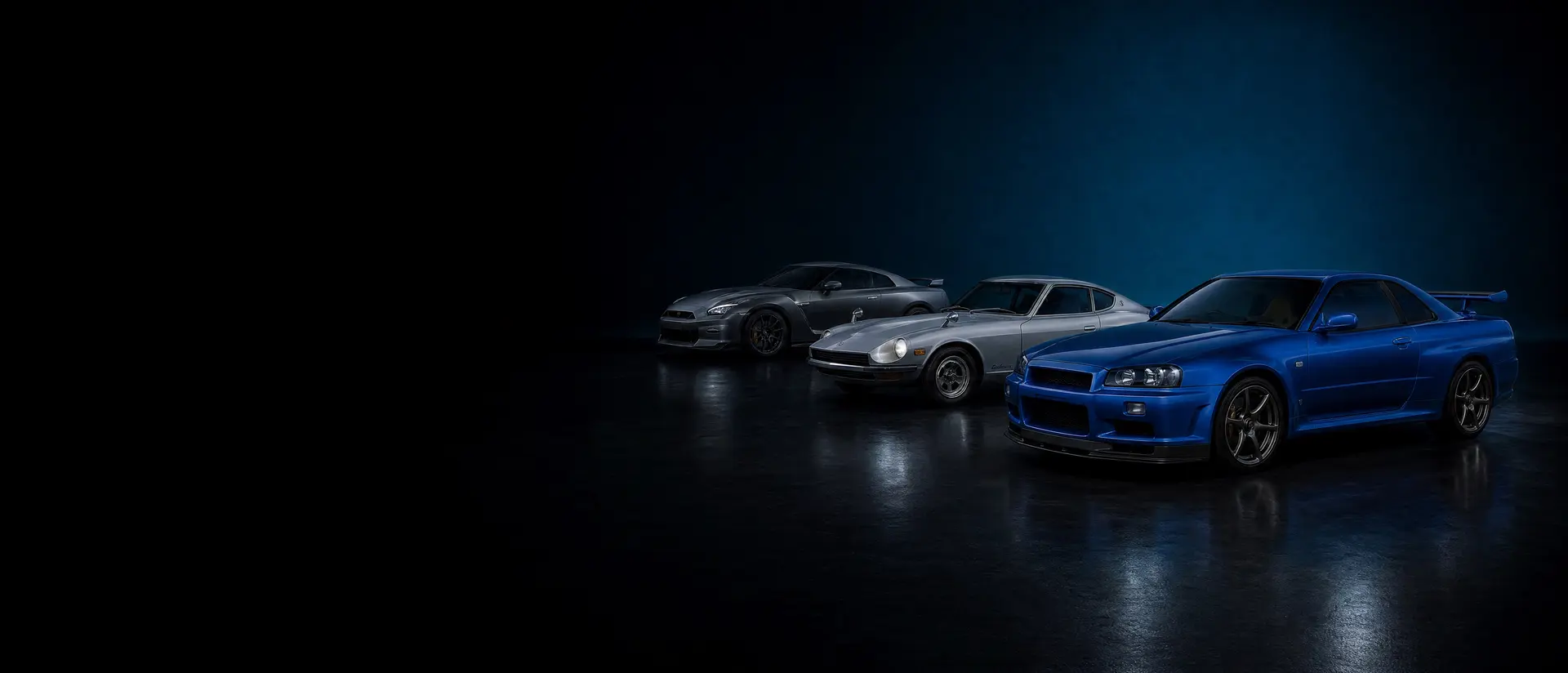
Forthcoming lots
2 forthcoming lots · Monterey 2026
The house
Yoshisuke Aikawa’s Nihon Sangyo and Tobata Casting established Jidosha Seizo Co., Ltd. in Yokohama on 26 December 1933; Aikawa became its president. The company was renamed Nissan Motor Co., Ltd. in June 1934. Nissan’s roots also include Masujiro Hashimoto’s Kwaishinsha, established in 1911, which completed the DAT car in 1914. In April 1935, the first car made by a fully integrated assembly system came off the Yokohama line.
Datsuns were first exported in June 1934. Nissan’s 1966 merger with Prince Motors brought the Skyline and Gloria into its range and transferred the Murayama Plant. The Skyline 2000GT-R’s S20 six applied technology from the Nissan R380 prototype-racing engine.
The Skyline 2000GT-R went on sale in Japan in February 1969 as a four-door PGC10; the shorter, lighter KPGC10 hardtop followed in 1970. Its first victory came at Fuji on 3 May 1969, and Nissan records 52 domestic touring-car victories when its works team stopped in October 1972. The KPGC110 was built from January to April 1973; 197 cars were completed before stricter emissions standards ended production. The Fairlady Z S30 appeared in 1969 and recorded global sales of more than 520,000 over nine years.
The R32 Skyline launched in May 1989 and the GT-R returned three months later with the RB26DETT and ATTESA E-TS all-wheel drive. R32 GT-Rs won all 29 Group A All Japan Touring Car Championship rounds from 1990 to 1993. In 2007, the GT-R returned as the standalone Nissan GT-R, without the Skyline name; its VR38DETT engines were assembled at Yokohama by Nissan’s Takumi specialists.
Nissan Motor Co., Ltd. continues to manufacture and sell automotive products from Yokohama. It has been part of the Renault-Nissan-Mitsubishi Alliance since 1999. The 2023 Alliance agreement established an approximately 15% cross-shareholding and a 15% voting-right cap; a May 2025 amendment reduced the minimum mutual lock-up obligation to 10%. Nissan and Honda terminated their December 2024 business-integration memorandum on 13 February 2025, while continuing their strategic partnership on intelligence and electrification.
Selected milestones
1933
Jidosha Seizo is established
Nihon Sangyo and Tobata Casting establish Jidosha Seizo Co., Ltd. in Yokohama on 26 December, with Yoshisuke Aikawa as president.
1935
The Yokohama line starts
The first car manufactured by a fully integrated assembly system rolls off the Yokohama line in April. Nissan identifies the plant as Japan’s first integrated automobile-production facility.
1966
Prince Motors merges with Nissan
Nissan merges with Prince Motors in August, acquires the Murayama Plant, and adds the Skyline and Gloria to its range.
1969
GT-R and Fairlady Z appear
The four-door Skyline 2000GT-R goes on sale in February with the S20 four-valve DOHC six. The Fairlady Z S30 appears later that year.
1989
The R32 GT-R returns
The R32 Skyline launches in May and the GT-R returns three months later with RB26DETT power and ATTESA E-TS all-wheel drive. R32 GT-Rs win all 29 Group A JTCC rounds from 1990 to 1993.
What defines Nissan
The Yokohama Plant was designed to incorporate vehicle production from parts manufacture to final assembly, and produced its first fully integrated-assembly car in 1935.
The first Skyline GT-R’s S20 applied technology from the R380 prototype-racing engine. Nissan developed the R32 GT-R with Group A competition in view, pairing RB26DETT power with ATTESA E-TS all-wheel drive.
The S30 was sold as the Fairlady Z in Japan and as the Datsun 240Z in North America; Nissan records more than 520,000 global S30 sales over nine years. The R35 was released as the Nissan GT-R, without the Skyline name.