Performance through lightness
Porter used a comparatively compact T-head four in a low, light chassis when large-displacement engines dominated performance motoring.
USA · est. 1909
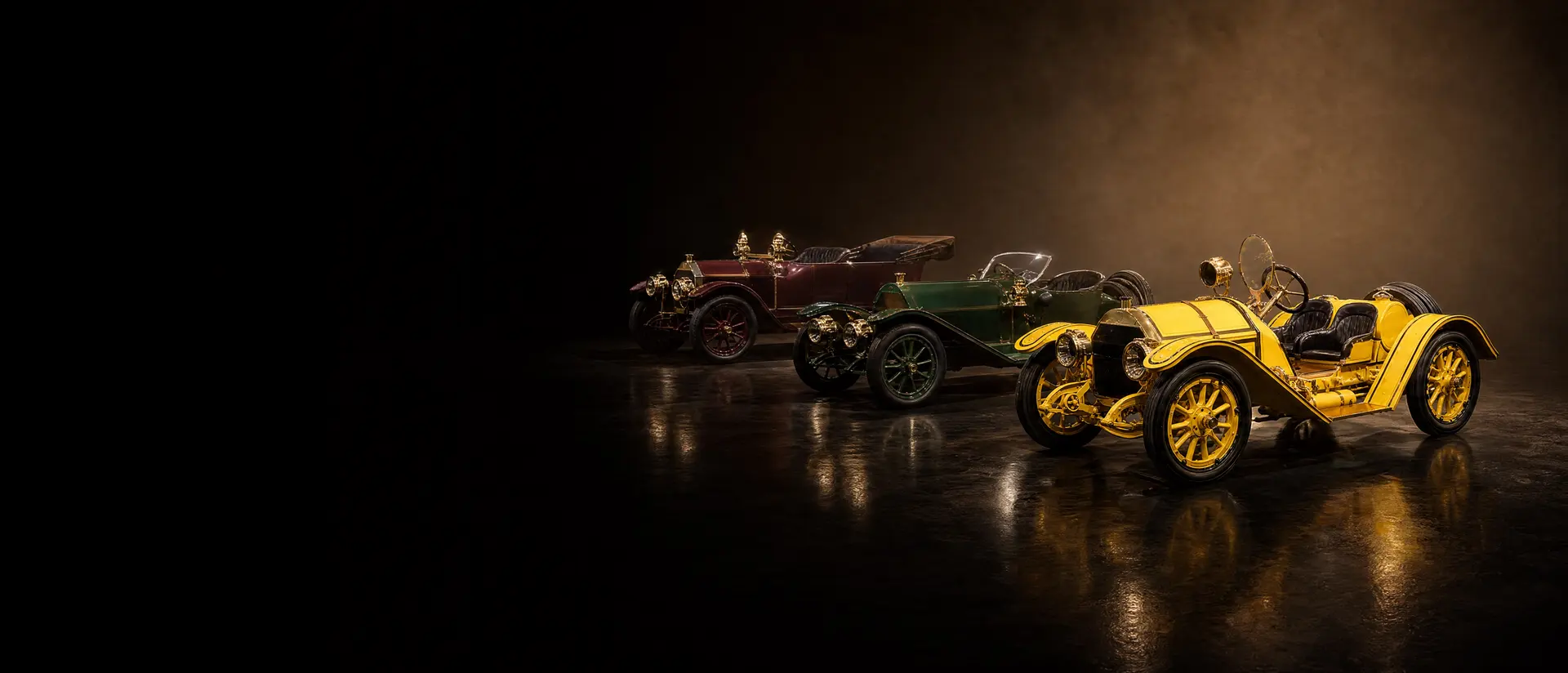
Mercer’s defining model was the Raceabout.
Forthcoming lots
1 forthcoming lot · Monterey 2026
The house
Mercer Automobile Company was formed in 1909 from the Walter Automobile Company and operated at Whitehead Road in Hamilton Township, New Jersey. Its first cars arrived in 1910 with four-cylinder L-head engines and were offered as speedsters, toy tonneaus, and touring cars.
For 1911, Washington A. Roebling II commissioned engineer Finley Robertson Porter to create the Type 35 Raceabout. Its light, low chassis carried a T-head four of about 300 cubic inches, two bucket seats, and a transverse fuel tank; it had no doors, while a monocle windscreen was optional. The 1911–12 cars had three forward gears and the 1913–14 cars four; Mercer guaranteed a mile in 51 seconds.
Raceabouts won five of six major 1911 contests. At the inaugural Indianapolis 500, Hughie Hughes finished twelfth and Charles Bigelow fifteenth in Mercers; Hughes finished third overall in 1912. Eddie Pullen, who had worked for Mercer as a mechanic, won the 1914 American Grand Prize at Santa Monica in a Mercer, covering 48 laps—404.016 miles—at 77.32 mph.
Porter left in 1914. Eric H. Delling’s 1915 Model 22-70 Raceabout used an L-head four on a 115-inch wheelbase, seven inches longer than the Model 35, while retaining a roofless and doorless layout. Washington A. Roebling II died in the Titanic disaster in 1912; the 1914 Elgin crash killed Spencer Wishart and mortally injured his riding mechanic, John Jenter, after which Mercer withdrew from factory campaigning. The original company built its last vehicle in 1925; a separate Mercer display followed in 1931.
Selected milestones
1909
Mercer is formed
The Roebling and Kuser families formed Mercer from the Walter Automobile Company; production operated at Whitehead Road in Hamilton Township.
1911
The Type 35 Raceabout
Porter’s T-head Raceabout combined a low, light chassis with two bucket seats and a transverse fuel tank. Mercer guaranteed it to cover a mile in 51 seconds.
1912
Third at Indianapolis
Hughie Hughes finished third overall in a Mercer at the 1912 Indianapolis 500. Washington A. Roebling II also died in the Titanic disaster that year.
1914
Grand Prize and withdrawal
Eddie Pullen won the American Grand Prize at Santa Monica. Later that year, the Elgin crash killed Spencer Wishart and mortally injured John Jenter; Mercer withdrew from factory campaigning.
1925
The original company ends
Mercer built its last vehicle in 1925. A later Mercer was displayed in 1931, but it was not a continuation of the original manufacturer.
What defines Mercer
Porter used a comparatively compact T-head four in a low, light chassis when large-displacement engines dominated performance motoring.
The Raceabout dispensed with conventional bodywork aft of the cowl and used twin bucket seats ahead of a transverse fuel tank. It had no doors; the monocle windscreen was optional.