Result-sheet label
Use Stevens/Miller only for the designation in IMS's Make/Model field, not as proof of an incorporated manufacturer or uniform component provenance.
USA · est. 1931
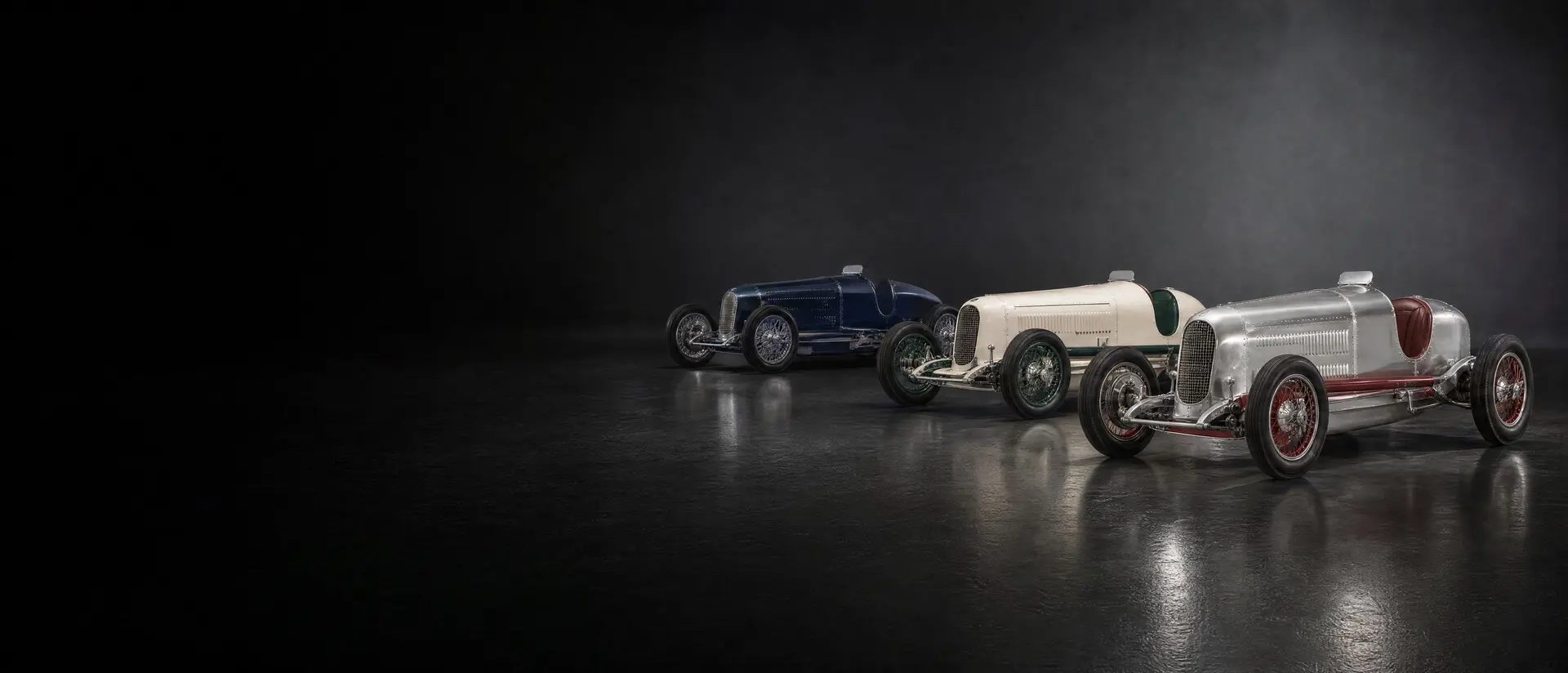
Stevens/Miller: two Indianapolis wins under a contested result-sheet label
Forthcoming lots
1 forthcoming lot · Monterey 2026
The house
From 1922 through 1926, Myron Stevens built frames, fuel tanks and bodies for almost all Harry Miller Specials, according to the IMS Museum. He then helped construct Frank Lockhart's Stutz Black Hawk land-speed car; after Lockhart's fatal 1928 crash, Stevens opened his own shop and continued building Indianapolis cars into the early 1950s.
The 1930 Indianapolis rules opened displacement to 366 cubic inches, barred supercharging except for two-cycle engines and again required riding mechanics. In that year's official IMS results, Shorty Cantlon, Louis Schneider, Louis Meyer and Dave Evans are listed as Stevens/Miller in the Make/Model column; Bill Cummings, fifth, is listed as Stevens/Duesenberg.
IMS records Louis Schneider's Bowes Seal Fast as Stevens/Miller in 1931: it started thirteenth, won at 96.629 mph and led 39 laps. Five IMS-listed Stevens/Miller cars started; the Jadson entered by Louis Meyer was classified fourth after a shared Stevens-Meyer drive. Schneider also headed the 1931 AAA Championship standings.
Harry Miller filed for bankruptcy in 1933 and his company was acquired by Fred Offenhauser. In 1936, IMS records Louis Meyer's Ring Free as Stevens/Miller; Meyer won from twenty-eighth on the grid at 109.069 mph, leading 96 laps, for his third Indianapolis 500 victory. The official winners table records no later Stevens/Miller winner.
Stevens's later work must be kept separate from the Stevens/Miller result-sheet label: IMS records Jerry Hoyt's 1955 pole car as Stevens/Offy.
Selected milestones
1922–1926
Miller Specials
IMS Museum credits Stevens with building frames, fuel tanks and bodies for almost all Harry Miller Specials in this period.
1928
Independent shop
Following Frank Lockhart's fatal Daytona Beach crash, Stevens opened his own shop.
1930
IMS lists Stevens/Miller
The official result table lists Cantlon second, Schneider third, Meyer fourth and Evans sixth as Stevens/Miller; Cummings fifth is Stevens/Duesenberg.
1931
Schneider wins the 500
IMS records Schneider's Stevens/Miller Bowes Seal Fast as winner from thirteenth, at 96.629 mph with 39 laps led. ChampCarStats lists Schneider as AAA champion.
1933
Miller bankruptcy
IMS Museum records Miller's 1933 bankruptcy and acquisition of his company by Fred Offenhauser.
1936
Meyer's third 500
IMS records Meyer's Ring Free as Stevens/Miller, winning at 109.069 mph with 96 laps led.
1955
Stevens/Offy pole
Jerry Hoyt started from pole in a Stevens/Offy; IMS Museum identifies it as a car constructed by Stevens.
What defines Stevens-Miller
Use Stevens/Miller only for the designation in IMS's Make/Model field, not as proof of an incorporated manufacturer or uniform component provenance.
The 1930 rules permitted up to 366 cubic inches, prohibited supercharging except on two-cycle engines and required riding mechanics.
Specialist research disputes several 1930 Stevens attributions, so individual chassis histories require car-specific evidence.