Safety-led packaging
The Tucker ’48 combined a padded crash-board cowl, passenger safety compartment, pop-out windshield and a directional centre headlamp. Seat belts were debated but not fitted.
USA · est. 1944
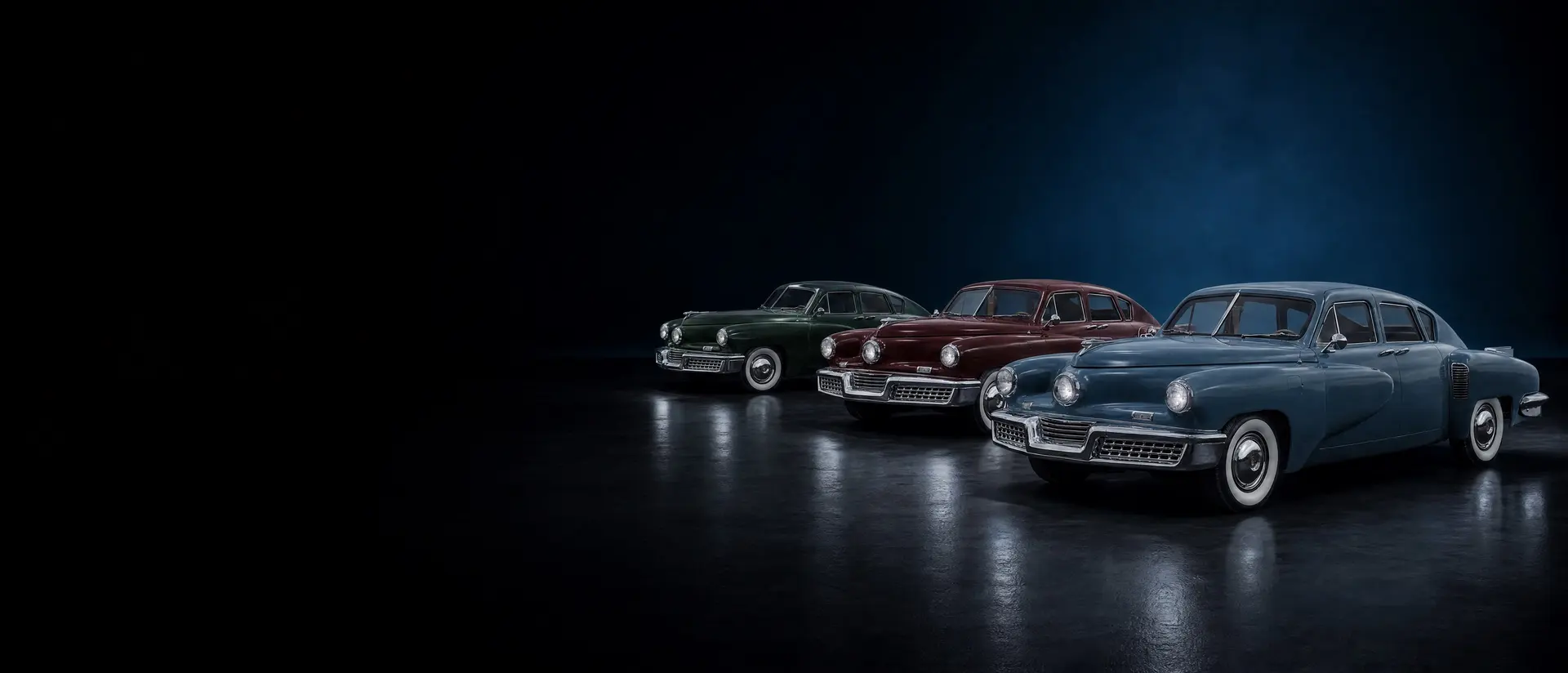
The Chicago-built Tucker ’48: 51 original cars and a defunct corporation.
Forthcoming lots
1 forthcoming lot · Monterey 2026
The house
Preston Thomas Tucker (1903–1956) worked with Harry Miller on Indianapolis racing cars and founded Ypsilanti Machine & Tool in 1939. With engineer Ben Parsons and former General Motors stylist George S. Lawson, he developed the original Tucker automobile plan in 1944–45; the Torpedo existed in renderings and models. Tucker Corporation itself was incorporated on 8 July 1946.
Tucker pursued the former Dodge Chicago aircraft plant on Cicero Avenue after incorporation. The War Assets Administration confirmed the company had secured the factory lease in November 1947. Alex Tremulis refined Tucker's initial concepts into the workable fastback design that became the Tucker ’48; the Torpedo name belonged to the earlier promotional and concept phase.
The production Tucker ’48 used a rear-mounted, water-cooled 335-cubic-inch Franklin O-335 flat-six adapted by Tucker engineers from an Aircooled Motors helicopter engine after the A-589 programme was abandoned. It had four-wheel independent rubber-torsion suspension, a Cord-based four-speed transaxle, a padded crash-board cowl, a passenger safety compartment, a pop-out windshield and a centre headlamp that turned with the front wheels.
The Tin Goose prototype was built between January and 19 June 1947. Car 1001, the first production Tucker ’48, was completed on 9 March 1948. The authoritative total is 51 original automobiles: the Tin Goose plus 50 production Tucker ’48s; 37 serial production cars had been built when the plant closed in summer 1948, while parts and engines enabled the final total to be completed later that year.
An SEC investigation began in May 1948, and Drew Pearson's June broadcasts brought it national attention. Federal bankruptcy trustees took control in March 1949; Tucker and his associates were acquitted on 22 January 1950, and the remaining assets were auctioned in October. The original Tucker Corporation is defunct. Preston Tucker LLC is a separate company formed in 2012 by Tucker's great-grandsons and currently operates a Tucker-branded merchandise and parts store.
Selected milestones
1944–45
The car plan takes shape
Tucker, George S. Lawson and Ben Parsons develop the original automobile plan. The Torpedo appears in renderings and models, not production.
1946
Tucker Corporation is incorporated
Tucker Corporation is officially founded on 8 July. Its pursuit of the Dodge Chicago plant begins in this period, but the confirmed lease comes later.
1947
Tin Goose and Chicago lease
The Tin Goose prototype is completed on 19 June. In November, the War Assets Administration confirms Tucker Corporation has secured the Chicago factory lease.
1948
The Tucker ’48 reaches production
Car 1001 is completed on 9 March. The company adopts the modified Franklin O-335 and a Cord-based transaxle as the original A-589 and fluid-coupling programme falls away.
1949–50
Bankruptcy, trial and liquidation
Federal trustees take control in March 1949. Tucker and his associates are cleared on 22 January 1950; the remaining assets are auctioned in October 1950.
What defines Tucker
The Tucker ’48 combined a padded crash-board cowl, passenger safety compartment, pop-out windshield and a directional centre headlamp. Seat belts were debated but not fitted.
The production car kept the rear-engine layout, using a modified 335-cubic-inch Franklin O-335 flat-six. Rear-fender vents fed cooling air to the rear-mounted engine.
The original A-589 engine and fluid-coupling transmission did not reach production. Tucker instead used an adapted Cord four-speed transaxle, then developed the Y-1 and an unfinished automatic alternative while production was under way.