Chassis and coachwork
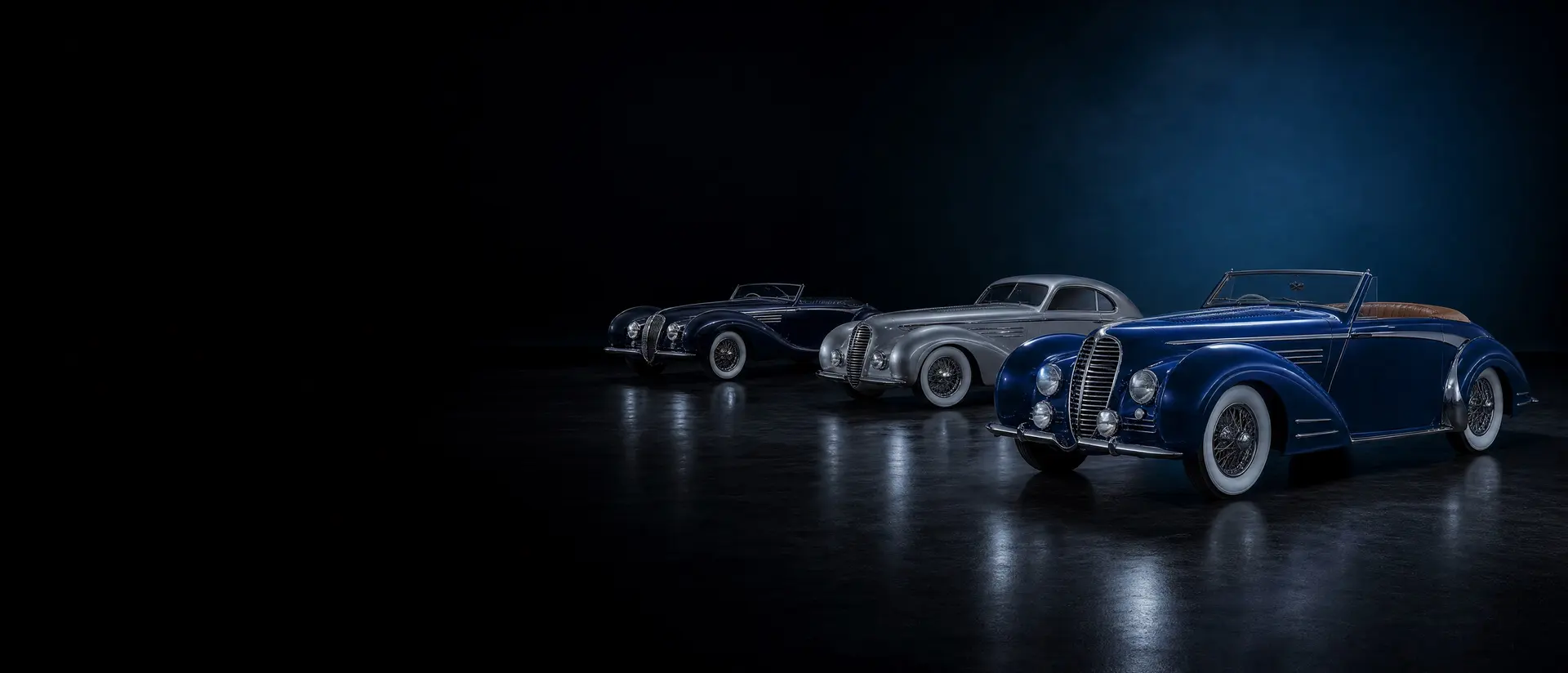
For the Type 135, Delahaye supplied the chassis while independent houses such as Figoni et Falaschi, Chapron, Saoutchik and Franay offered bodies.
France · est. 1894
The Type 135 supplied the chassis; Paris coachbuilders supplied the silhouette.
Forthcoming lots
2 forthcoming lots · Monterey 2026
The house
Engineer Émile Delahaye had taken over Julien Bréthon’s Tours engineering business in 1879. He showed his first car at Paris’s first motor show in 1894 and drove Delahayes in the 1896 Paris–Marseille event. In 1898, the business moved to 10 rue du Banquier in Paris after Delahaye joined Léon Desmarais and Georges Morane; Delahaye retired in 1901 and died in 1905.
The firm made cars alongside commercial and fire-fighting vehicles. Its direction changed toward prestige cars and organised competition in the early 1930s. The Type 135, introduced in 1935, used a 3.2-litre straight-six derived from a Delahaye truck engine; Jean François is credited as its designer.
The Type 135 chassis was offered to independent coachbuilders including Figoni et Falaschi, Chapron, Saoutchik and Franay. René Le Bègue and Julio Quinlin won the 1937 Monte Carlo Rally in a Delahaye 135 MS Spéciale. At Le Mans in 1938, Eugène Chaboud and Jean Trémoulet won outright, ahead of Yves Giraud-Cabantous and Gaston Serraud in another Delahaye.
Lucy O'Reilly Schell’s Écurie Bleue campaigned Delahaye competition cars. René Dreyfus won the Prix du Million in a Type 145 in 1937 and the Pau Grand Prix in 1938. Two Figoni et Falaschi Type 165 V12 roadsters, chassis 60743 and 60744, are documented. Delahaye merged with Hotchkiss in 1954; Club Delahaye dates the combined firm’s end of passenger-car manufacture to 1955.
Selected milestones
1894
First car shown
Émile Delahaye showed his first automobile at Paris’s first motor show.
1898
Move to Paris
Delahaye joined Léon Desmarais and Georges Morane, and the business moved to 10 rue du Banquier in Paris.
1935
Type 135 and Delage
The Type 135 was introduced at the Paris Motor Show; Delahaye also took over Delage that year.
1937–38
Rally, record and endurance success
Le Bègue and Quinlin won Monte Carlo in 1937; Dreyfus won the Prix du Million in 1937 and Pau in 1938; Delahaye finished first and second at Le Mans in 1938.
1954–55
Merger and final passenger cars
Delahaye merged with Hotchkiss in 1954. Club Delahaye dates the combined company’s end of passenger-car manufacture to 1955.
What defines Delahaye
For the Type 135, Delahaye supplied the chassis while independent houses such as Figoni et Falaschi, Chapron, Saoutchik and Franay offered bodies.
The Type 135’s 3.2-litre straight-six derived from a Delahaye truck engine. It had independent leaf-sprung front suspension; short-wheelbase competition variants used a distinct 2.70 m chassis.
Delahaye had an official competition department whose cars were entrusted to the Schells’ Écurie Bleue, while private customers also entered sporting events.