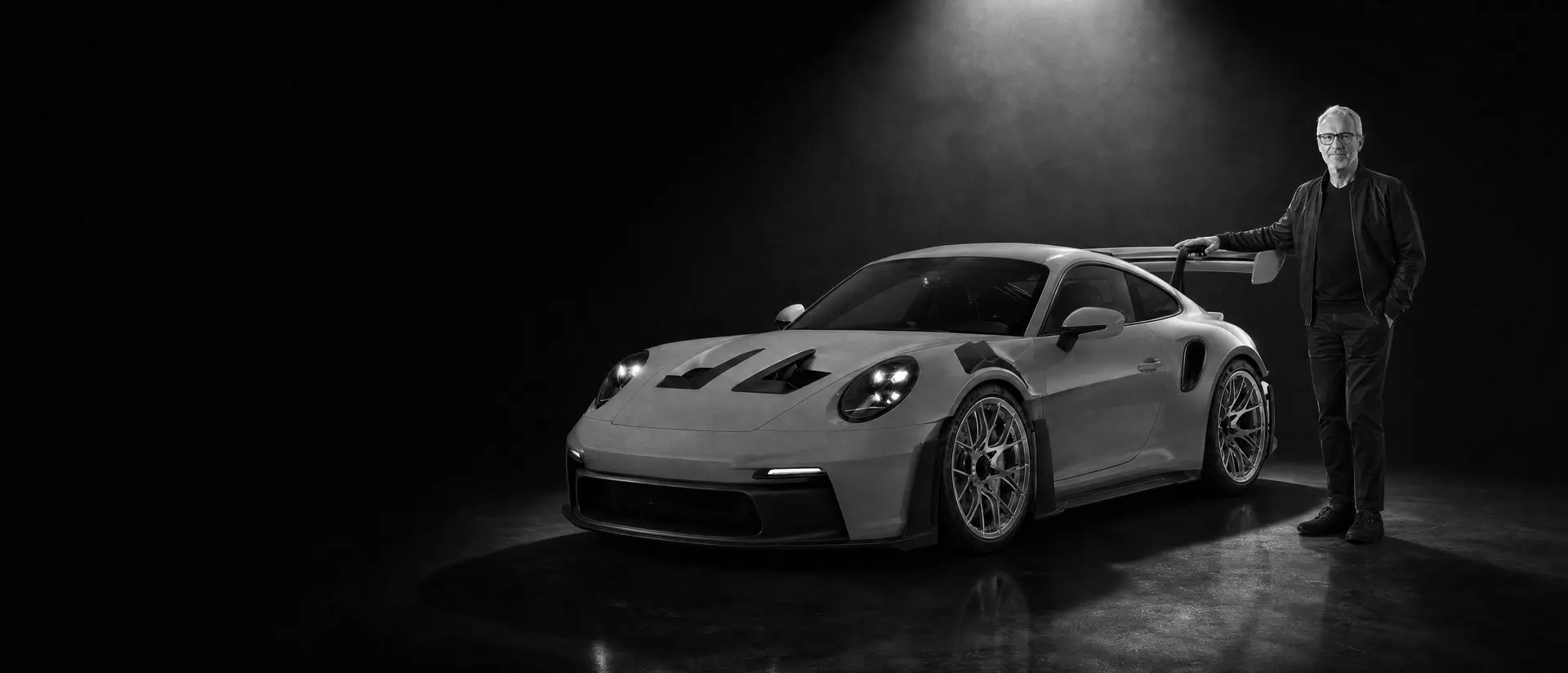
Andreas Preuninger standing beside a Porsche 992 GT3 RS under a single spotlightAI-generated

People · Engineer · b. 1965

Andreas

aus dem Rennsport, für die Straße

Born
1965
Department
Porsche GT Model Line
At Weissach
Since 2000
In the register
Six files

The series-keeper

Preuninger did not author the first GT3 of 1999 — his work is everything since. From the second-generation 996 GT3 onward he has run Porsche’s GT road-car programme as one continuous line: race-car technology transferred directly, with road usability and driver engagement held as explicit requirements, not casualties.

He freelanced for auto motor und sport while studying, spent two years at a Porsche supplier, then joined Porsche’s engineering consultancy before moving to Weissach in 2000. There the GT department keeps race and road engineers in the same rooms — and keeps the manual gearbox on the option sheet by conviction. The rail below holds the six files where the method is documented.

The register

From the 4.0 to the S/T

One department, one unbroken line. Every file below carries the GT Model Line’s stamp; the rail runs in build order.

Signature moves

The manual, the wing, the rev limit

Race to road

Race-car and GT-road-car engineers sit in the same teams at Weissach — Porsche quotes him calling it the most direct technology transfer there is.

The manual case

Purist, lightweight manual specifications where they fit the car’s purpose — argued for the Cayman GT4, restated by the 911 R and the S/T.

Function-led aero

GT3 development runs on simulation and wind-tunnel work with race-derived wing logic. The 992 RS made the aero active; the function stayed first.

The high rev

High-revving naturally aspirated powertrains held in the GT3 and 718 GT4/Spyder programmes while the rest of the range turbocharged.

GT beyond the 911

The GT treatment extended to the mid-engined Cayman platform — the GT4 line as a deliberate second front, not a diluted one.

Road, Touring, track

Use cases separated on purpose rather than treating lap time as the sole objective — one engine, three honest specifications.

The archive

Prints from Weissach

Press photographs from the GT department’s launches — choose a print and it pushes the others aside.

Up the hill in the 997 GT3 3.8, Goodwood 2009. Ian McWilliams, CC BY 2.0.

Beyond the register

From the 996 GT3 RS to the GT4 RS

Selected works under his documented GT-programme leadership — a department’s output, not a claim of sole authorship.

'03–'10

996.2 GT3

The second-generation GT3 — the point where the continuous programme under Preuninger begins.

996 GT3 RS

One of his first Porsche projects, and the first RS of the water-cooled GT line.

997 GT3 · GT3 RS

The Mezger-engined generations carried forward toward the 4.0.

997 GT2 RS

The turbocharged RS treatment, ahead of the 991 file in the register.

'13–'17

991 GT3 · 991.2 GT3

The GT3 renewed twice under his model line.

Cayman GT4

The GT treatment reaching the mid-engined platform for the first time.

991 GT3 Touring Package

The wingless, manual GT3 — the use cases formally separated.

'19–'21

718 Cayman GT4 · 718 Spyder

The naturally aspirated, high-revving answer within the 718 range.

992 GT3

The current GT3, developed with race-derived aero logic.

718 Cayman GT4 RS

The RS method applied to the mid-engined car.

In his words

“A bit of every victory from racetracks all over the world is contained in every GT3.”

Andreas Preuninger · Porsche, 25 years of the 911 GT3, 2024