GT40

Built to finish first

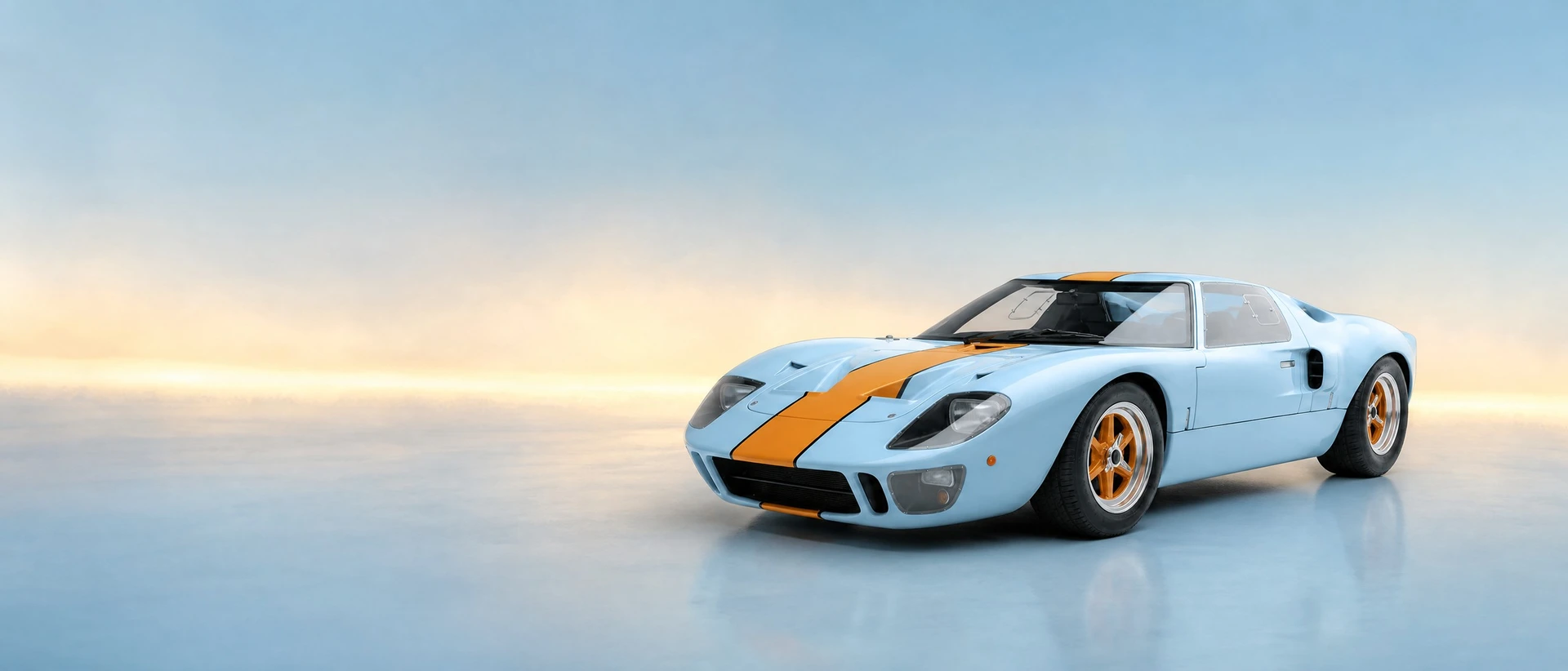
Ford built the GT40 to win Le Mans. The Mk II swept the podium in 1966, the Mk IV won in 1967, and John Wyer's Mk I won in 1968 and 1969. Chassis identity, period race history and exact Mark outweigh headline specification.

Market value · road

$4.0M$9.5M

Typical $7.0M · 11 sales · +305% vs ’19–’20

$6K$14M
Open Market & Price

Market value · road

$4.0M$9.5M

Typical $7.0M · 11 sales · +305% vs ’19–’20

$6K$14M
’04’26
Market history · in the terminal
Open Market & Price
Height
40 in (1'016 mm · source of the name)
Power
345–485 bhp (Mk I road car to 1966 Mk II)
Engines
289 / 427 cu in (4.7 / 7.0L Ford V8)
Transmission
4- or 5-speed (manual transaxle)
Wheelbase
95 in (2'413 mm · Mk I)
Le Mans
4 wins (1966 to 1969)

Market & Price

The price and the proof

A terminal for one car: the model curve over the documented record, the benchmarks it is measured against, and the instruments that read it.

Records: 1966 Mk II P/1032 — $13,205,000 · RM Sotheby's, Miami · 2025; 1968 Gulf/Mirage P/1074 — $11,000,000 · RM Auctions, Monterey · 2012. 1965 roadster prototype GT/108 — $7,650,000 · RM Sotheby's, Monterey · 2019.

HCN:GT40Live model
$7'011'472-43.8% · 12M
$10K$20K$50K$100K$200K$500K$1M$2M$5M$10M20182020202220242026CovidRate shockS&P 500
Model curve · anchored to 25 documented salesnot investment advice
The readouts · model figures against the benchmarks25 documented anchors · last sale 6 mo ago

Compound annual growth

WindowThis car*S&P 500Gold
1Y-43.8%+18.8%+21.9%
5Y+19.6%+11.4%+17.6%
10Y+7.2%+13.3%+11.8%

*Modeled price CAGR · S&P is a price index, no dividends

Deepest drawdown · model window

This car*-99.9%Aug 2018Oct 2019 · recovered Feb 2025
S&P 500-50.8%Oct 2007Mar 2009 · recovered Mar 2013
Gold-39.3%Sep 2011Dec 2015 · recovered Jul 2020

Forecast ladder · model quantiles

HorizonP10P50P90
+6M$5.8M$7.1M$8.6M
+12M$5.5M$7.2M$9.3M
+24M$5.0M$7.3M$11M

Median path with the 10th and 90th percentile · not investment advice

Transaction ledger · documented sales

25 of 25 recorded sales · shown in USD · recorded currency in each record

Public results separate into road cars near the lower end and competition cars with period results at the upper end. GT/108 moved from $6.93 million in 2014 to $7.65 million in 2019; the 2025 Mk II sale set the latest public benchmark in this ledger.

Price range · road · openConfidence · mediumSeven documented RM auction sales support the range, including two sales of the same roadster prototype. The sample mixes road Mk I cars, prototypes, Gulf competition history and works Mk IIs; it supports a model-wide envelope, not a price for an unidentified chassis.

Floor

$4.0M

Typical

$7.0M

Ceiling

$9.5M

Estimate band for good road cars. 11 documented sales since 2019 plotted below.

$6K$4.0M$7.0M$9.5M$14M
Hover the spectrum to read a value, or a dot for the sale behind it.

Band and axis shown in USD. Sale positions use indicative fixed-rate conversion to USD; sale readouts retain recorded currencies. USD, model-wide. Original tub, period race record, specification, continuous ownership history and the quality of any restoration decide where a car sits.

Road record

$13,205,000

1966 Mk II P/1032

RM Sotheby's, Miami · 2025

Road record

$11,000,000

1968 Gulf/Mirage P/1074

RM Auctions, Monterey · 2012

Road record

$7,650,000

1965 roadster prototype GT/108

RM Sotheby's, Monterey · 2019

The wider market · Ford at auction · median per year · modeled between anchors1,593 lots · 2003–2026 · exact yearly anchors · modeled line

Instrument calibration for this file is in progress — the terminal above reads the documented record directly.

RM published results are recorded as prices with buyer's premium. Replicas, continuation cars, tool-room copies and no-sales are excluded.

Overview

Ten months to the first start

After negotiations to buy Ferrari ended in 1963, Ford formed a unit to build a GT capable of winning Sebring and Le Mans. Roy Lunn supplied the internal concept; Eric Broadley's Lola Mk 6 GT informed the package; John Wyer organised the programme in Britain. Ford Advanced Vehicles moved into Slough and completed the first car in April 1964.

The 1964 cars were fast and fragile. All three retired at Le Mans, with the Colotti transaxles unable to survive the load. Ford moved operational control to Carroll Shelby and engineering control to Lunn; Ken Miles and Phil Remington then worked through suspension, cooling, aerodynamics and the gearbox problem.

A 427-powered test car reached 210 mph in 1965, but Ford again failed to finish at Le Mans. For 1966 the Mk II received a four-speed transaxle, endurance-tested 485 hp engines and serviceable brake assemblies. Bruce McLaren and Chris Amon won ahead of Ken Miles and Denny Hulme, with Ronnie Bucknum and Dick Hutcherson third.

The Dearborn-built Mk IV won in 1967. Ford then withdrew its factory team, but the older five-litre Mk I remained eligible in the Sport category. John Wyer Automotive won in 1968 and 1969 with the same chassis, P/1075, completing four consecutive overall victories for the GT40 line.

Layout
Mid-engine V8
Ford count
126 built
Road Mk I
31 cars
Works wins
1966 · 1967
Privateer wins
1968 · 1969
Origin
Slough · Dearborn

Reference

Technical specifications

Mk I road specification

Engine
289 cu in OHV V84'727 cc, four Weber 48IDA carburettors
Power
345 bhpperiod road-car figure published by RM Sotheby's
Gearbox
ZF 5-speed manualrear transaxle
Suspension
Independent front and rearunequal-length front arms; trailing-arm rear layout
Brakes
Four-wheel discs
Wheelbase
95 in2'413 mm

1966 Mk II race specification

Engine
427 cu in OHV V87.0L big-block developed for endurance use
Power
485 hp at 6'400 rpmFord's 48-hour dynamometer specification
Gearbox
4-speed manualthe 427's torque made a fifth ratio unnecessary
Brakes
Quick-change discs and callipersdeveloped for repeated stops from more than 200 mph
Construction
Steel monocoqueheavier-gauge sections than the Mk I

The records

0

consecutive Le Mans wins

1966 to 1969

0

cars on the 1966 podium

first, second and third

0in

nominal height

the name made literal

0

road-spec Mk I cars

RM Sotheby's figure

HICON BID

Buying interest, silently.

A HICON Bid is a confidential expression of buying interest on the Ford GT40 file — never public, never shown to other members. It is not a binding purchase, and HICONIUM holds no funds.

Sign in

HICON Bids are a member instrument. Sign in to place one.

The vault

Open a file on yours.

You keep one? The record starts in your garage — identity, papers, photography, and the market evidence this file already carries, bound to your chassis.

The variants

One badge, 4 executions

The register separates the GT40 into its documented executions. One reference silhouette per execution — each opens as its own file as the archive fills.

Ford GT40 Mk I — reference silhouetteMk I01
Reference in preparationMk II02
Reference in preparationMk III03
Reference in preparationMk IV04

4 executions on file · references drawn to the house standard

The cars

The GT40 register

Documented individual cars — chassis, colour, ownership and sale history. Open one for its full provenance. Public records only; members see the complete registry.

07 documented · public records

The hands

The people behind the car

The people whose work shaped the Ford GT40.

No free period portrait on record

Roy Lunn

Chief engineer

Led Ford engineering on the GT programme and retained engineering control when development moved from Slough to the United States.

No free period portrait on record

Eric Broadley

Project engineer

Brought the Lola Mk 6 GT's mid-engine package into the programme and worked on the first GT40 prototypes in Britain.

No free period portrait on record

John Wyer

Programme and team manager

Set up the original race operation in Slough, then returned as an independent entrant to win Le Mans in 1968 and 1969.

Carroll Shelby

Competition director

Took operational control for 1965 and developed the programme from an unreliable prototype into the 1966 Le Mans winner.

Ken Miles

Development driver

Reset the early chassis, tested the 289 and 427 cars and produced the Le Mans dynamometer driving cycle used to prove the 1966 engines.