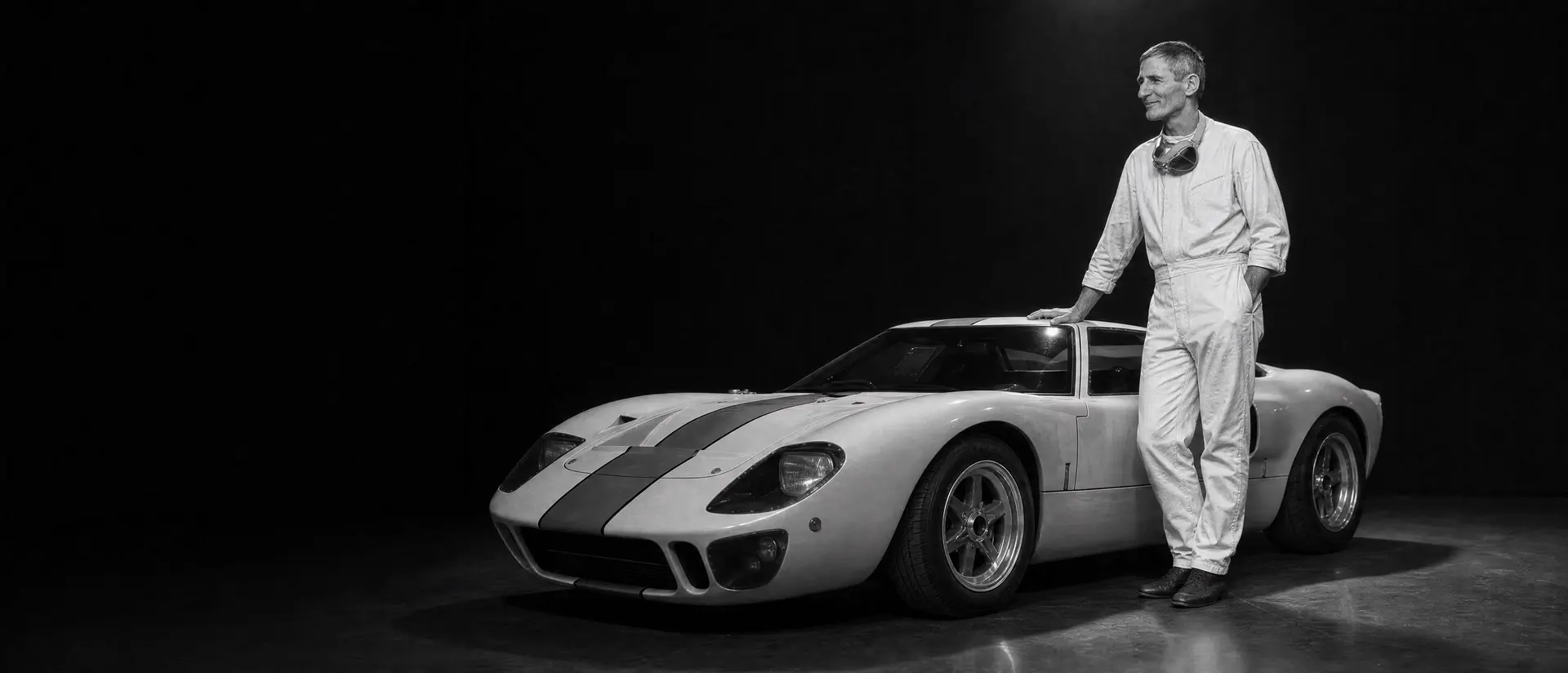
Ken Miles in white race overalls, goggles at his neck, one hand resting on the roof of a Ford GT40 under a single spotlightAI-generated

People · Development driver · 1918–1966

Ken

the racer among the engineers

Born
Sutton Coldfield, 1918
Died
Riverside, 1966
House
Shelby American, 1963–1966
In the register
Four files

The feedback loop

Miles drove to diagnose. A lap told him what the chassis, the cooling, the aerodynamics or the gearbox were withholding, and he altered the car until it stopped arguing — then drove again to check its answer. Rapid driver, inventive engineer, intuitive tester: one man as the whole measurement chain.

None of his four files claims styling authorship. They document practical development — the 289 Cobra’s springs and anti-roll bars, the Daytona Coupe’s Riverside proof, the GT40’s long correction and its 48-hour engine simulation, the 427’s test numbers. The cars kept the shapes others drew; Miles made them hold together for twenty-four hours.

Nineteen sixty-six

Daytona, Le Mans, Riverside

FEBDaytona

24 Hours of Daytona

The GT40’s first outright win, shared with Lloyd Ruby — the car he had spent two years resetting finally lasting the distance.

JUNLe Mans

24 Heures du Mans

Leading near the end, he was asked to slow the car for a three-abreast photograph, and did as instructed. McLaren and Amon took the classified win; Miles and Hulme were listed second.

AUGRiverside

J-car test, 17 August

Testing the programme’s next car at the circuit where he had proved the Daytona Coupe, Miles was killed. He was forty-seven. The four files carry his development work.

The method

The seat, the stopwatch, the spanner

The instrumented driver

Rapid driver, inventive engineer, intuitive tester — one man as the whole measurement chain. He drove the lap, read the car and wrote the change order himself.

Track to toolbox

Feedback became hardware. On the 289 Cobra that meant springs and anti-roll bars; on the GT40 it reached body, suspension, fuel, brakes and the gearbox.

The whole twenty-four hours

He tested the endurance problem, not the fast lap. His dynamometer tape reproduced Le Mans well enough for Ford to run the 1966 engines two days straight.

Parts, re-packaged

The Daytona Coupe kept the Cobra’s mechanicals and solved its straight-line deficit with a low-drag body. His Riverside test supplied the decisive number.

Racing as validation

His own MG Special took fourteen straight wins in 1953; the GT40 proved itself at Daytona. Competition was the test environment, never the publicity lap.

The archive

Prints from the paddock

Period photographs from the grids and banks he worked — choose a print and it pushes the others aside.

On the grid with the Dolphin Mk 2. Photograph Ray Crosthwaite, CC BY-SA 3.0.

Before the register

From Wolseley to the Pooper

'34–'46

Wolseley Motors

Left school in Birmingham for a mechanical apprenticeship — vehicle work before racing.

British Army · REME

Driving instructor, then Armament Artificer; discharged to the reserve a Staff Sergeant.

The 1943 letter

From service he wrote to Motor Sport proposing “a supercharged 4WD trials job of my own design”.

'52–'55

The MG Special

A tube-frame special of his own construction — fourteen consecutive victories in 1953.

'56–'62

Porsche Spyder

Campaigned for John von Neumann and Otto Zipper on the Californian circuits.

The “Pooper”

A Porsche-Cooper hybrid — his instinct for re-packaged parts, a decade before the Daytona Coupe.

Porsche RSK

The last of the Porsche drives before the factory work began.

Rootes & Dolphin

Alpine test work and Formula Junior development — the driver-engineer trade, made official.

The house

Shelby

Carroll Shelby’s shop holds Miles’s entire register: development driver, competition manager and engineer across the Cobra and GT40 programmes, 1963 to 1966. Shelby ran the programme and found the money; Miles told the cars what was wrong with them.

“He made a racehorse out of a mule.”

Carroll Shelby, on the Daytona Coupe

In his words

“I work for the Ford Motor Company … if they ask me to jump in a lake, why I guess I will have to do that as well.”

Ken Miles · on the 1966 Le Mans formation-finish instruction