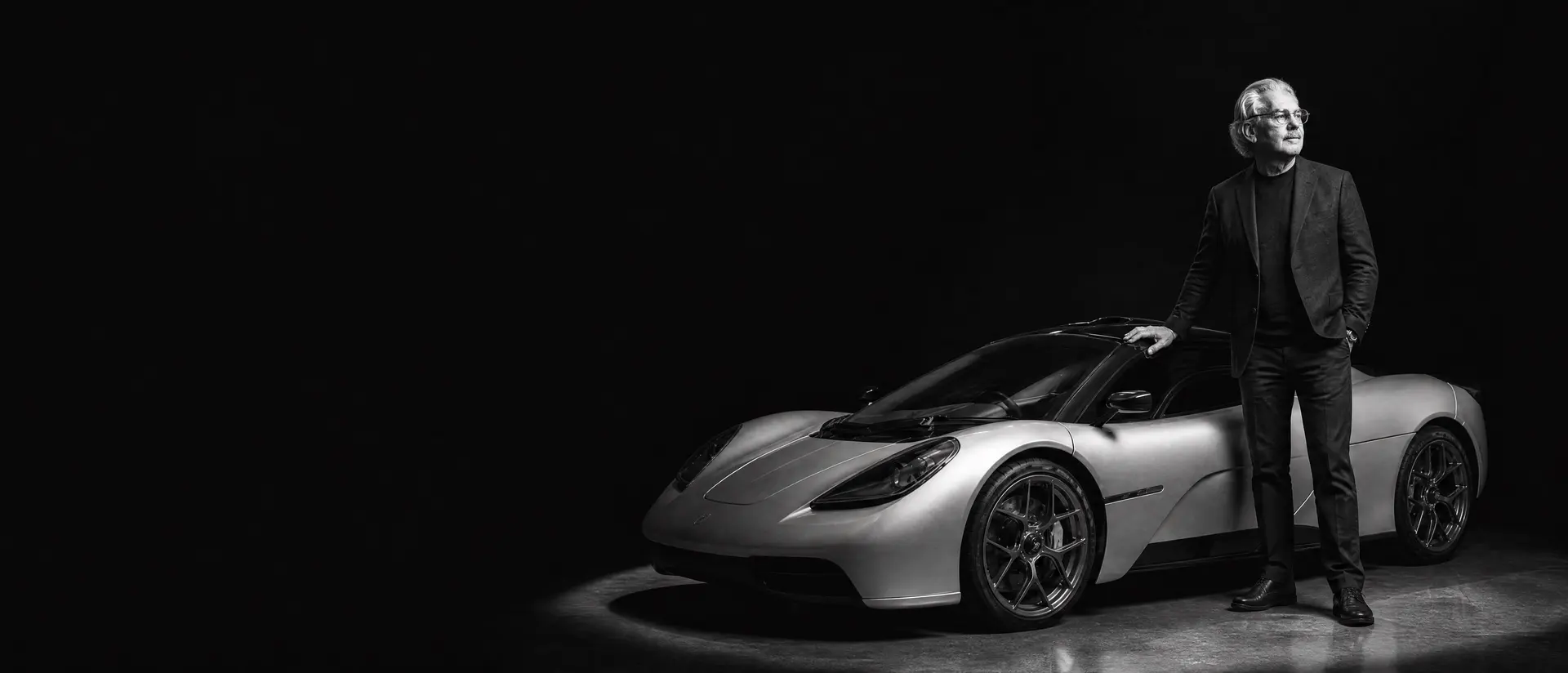
Gordon Murray standing beside a GMA T.50 under a single spotlightAI-generated

People · Engineer · b. 1946

Gordon

the engineer of lightness

Born
Durban, 1946
Houses
Brabham · McLaren · GMA
Today
Executive Chairman, Gordon Murray Group
In the register
Four files

First principles

Murray is the register’s engineer-author: a Formula One designer who carried grand-prix problem-solving into road cars whole — mass targets, purposeful packaging, the driver at the centre of the package. The four files below span one argument, not one styling language: the F1, its rapid conversion into the GTR, the SLR engineered in Woking, and the T.50 that restates the F1 from scratch.

The habits formed at Brabham — a fan where a wing should be, an engine tilted to get under the airflow, a car built around its driver rather than its bodywork — resurface in everything he has signed since. Sixty years into the numbering that began with the IGM T.1, the argument has not changed: take the weight out, give the driver the work, and let the package decide the shape.

One seat in the middle, the weight argued away

The register

From the F1 to the T.50

Engineering signatures

The seat, the fan, the gram

The central seat

The F1 put the driver on the centre line and made the package answer to him; the T.50 repeats the layout deliberately, three decades on.

The carbon monocoque

The F1 was the first road car built around a lightweight carbon-fibre tub. At GMA, lightweight construction is a product principle, not a statistic.

The rear fan

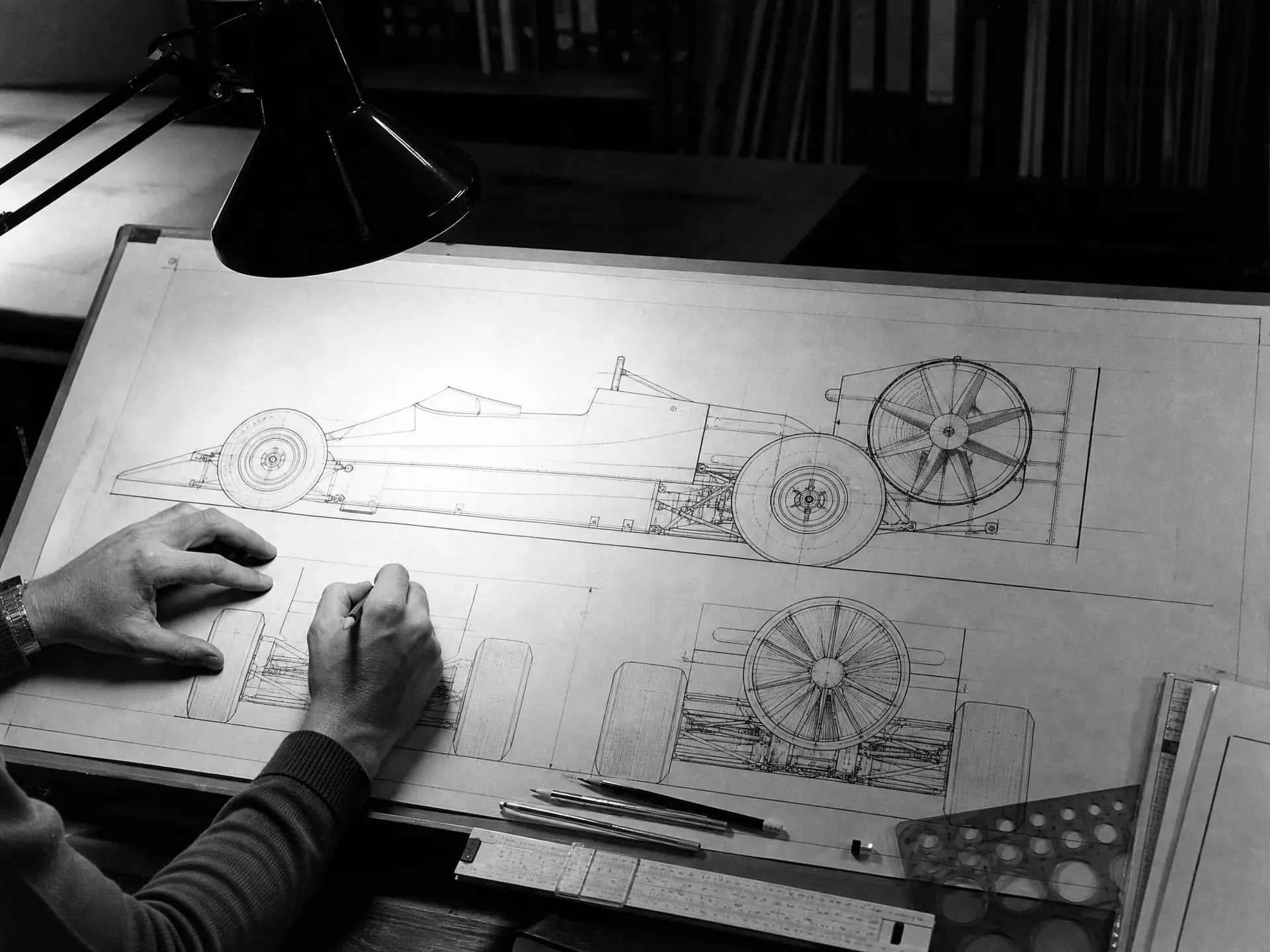
The BT46B pulled itself onto the road with an extractor fan; it won in Sweden and was withdrawn. The T.50 carries the same fan into road trim.

The low line

The BT55 tilted its engine and reclined its driver to get under the airflow. Murray later traced the MP4/4’s aerodynamic direction to that geometry.

The manual gearbox

The F1 brief refused electronic driver aids; the T.50 pairs its central seat with a six-speed manual. The driver is given work, on purpose.

iStream

A Formula One build process turned into a production system — the T.25 city car proved it, and TVR’s Griffith borrowed it for its composite structure.

The archive

Prints from the drawer

One paddock photograph and three editorial reconstructions — choose a print and it pushes the others aside.

Le Mans paddock, 1996. Photograph Martin Lee, CC BY-SA 2.0.

Beyond the register

From the IGM T.1 to the Griffith

'67–'86

IGM T.1

Designed, built and raced by Murray himself in South Africa — the first car of the sixty-year numbering.

Duckhams Ford LM

A three-litre Le Mans prototype drawn for Alain de Cadenet.

Brabham BT44

His first race-winning Formula One design, at Kyalami in 1974.

Brabham BT46B

The fan car — one start, one win in Sweden, withdrawn before anyone could reply.

Brabham BT55

The radical low-line — tilted engine, reclined driver, the packaging McLaren thinking later leaned on.

'88–'94

McLaren MP4/4

Built during his tenure as Technical Director; fifteen wins from sixteen races. Never claimed as his alone.

Light Car Company Rocket

A sub-400-kilogram tandem two-seater on a 145 bhp Yamaha engine. Weight as the whole argument.

'10–'17

GMD T.25

A low-carbon city car built to prove the iStream production process.

GMD T.27

The T.25 electrified — the same discipline at a smaller energy budget.

Global Vehicle Trust OX

A flat-pack all-terrain truck for low-cost mobility in development regions.

TVR Griffith

A sports car whose carbon-composite structure came off the iStream process.

The houses

Brabham, McLaren, his own name

Brabham

1969–1986

Hired as a junior designer, chief designer within a few seasons. Seventeen years of one-man design authority — BT44, BT46B, BT52, BT55 — from junior draughtsman to the team’s chief designer.

McLaren

1987–2005

Technical Director of the race team through the MP4/4 era, then founder of the road-car business in 1990. McLaren Cars built the F1, converted it into the GTR, and engineered the Mercedes-Benz SLR in Woking.

Gordon Murray

2007–present

His own name on the door: Gordon Murray Design from 2007, Gordon Murray Automotive from 2017. The T.50 closed the circle — central seat, rear fan, and a company organised around the gram.

In his words

“We were constantly looking for ways to be better than everyone else, not by a little bit, but by a lot.”

Gordon Murray · Motor Sport, 2021