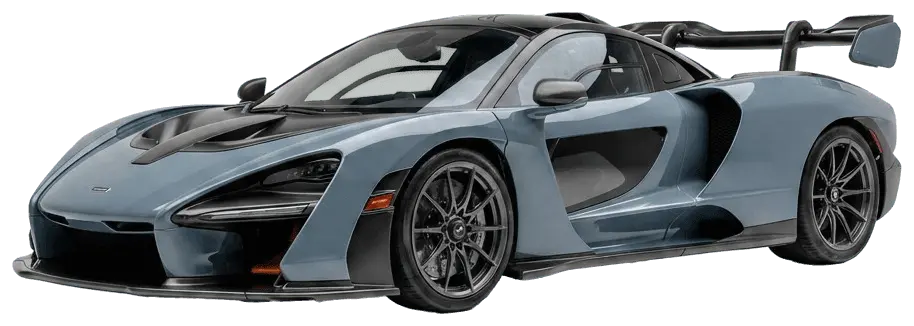
Function-led form
For the Senna, Melville treated 800 kg of downforce, cooling and legal requirements as inputs to the visible form. Four attached aerodynamic pods house radiators and active aero so the body shows how air enters, cools and leaves.
People
Chief Design Officer at Ceer
TopGear South Africa
The record
British automotive designer who led McLaren Automotive as design director from 2017 to 2022 and is credited in this register for the Senna and Speedtail. After Jaguar Land Rover and General Motors he spent thirteen years at McLaren. Since 2022 he has been Chief Design Officer at Saudi start-up Ceer.
The youngest of three brothers and son of an engineer, Melville studied vehicle design at the University of Huddersfield, then a Land Rover-sponsored master's in transportation design at the Royal College of Art. He graduated in 2003 into Land Rover's Advanced Design studio. McLaren later recorded that his sketches and clay were chosen for the LRX concept that became the Range Rover Evoque.
In 2006 he joined General Motors' UK Advanced Design studio as a senior designer. The Cadillac Converj was the highlight he later named. Frank Stephenson telephoned him in 2009 while he was taping a Cadillac clay. He joined McLaren that September; Form Trends recorded that on the P1 he designed the front and side, Paul Howse the rear.
McLaren made him chief designer in December 2014 and design director in May 2017, succeeding Stephenson. The company assigned him responsibility for developing its design strategy and principles alongside engineering and manufacturing. As chief designer he led the Sports Series, including the 570S, and the 720S. Under his direction the studio's published pillars included everything for a reason and truth to materials.
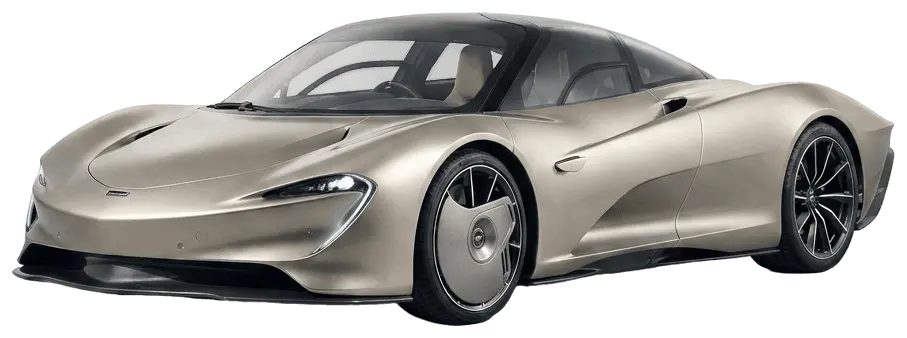
The register credits Melville as design director for the McLaren Senna and Speedtail. Discussing the Senna, he described balancing 800 kg of downforce at 250 km/h with road-car regulations, proportions and McLaren's surface language, and named the four aerodynamic pods as the form's clearest statement. On the Speedtail his team reduced cut lines and set flexible ailerons in a single-piece rear skin.
He left McLaren in 2022 after thirteen years, telling Car Design News that the completed Solus GT, begun as a 2011 vision sketch, closed his chapter. He moved to Riyadh as Chief Design Officer of Ceer, Saudi Arabia's first electric-car brand. Ceer still listed him in that role in August 2026.
For the Senna, Melville treated 800 kg of downforce, cooling and legal requirements as inputs to the visible form. Four attached aerodynamic pods house radiators and active aero so the body shows how air enters, cools and leaves.
On the Speedtail, Melville's team reduced body cut lines for appearance and aerodynamics. Flexible ailerons sit in a single-piece rear skin, their outer surface contiguous with the clamshell rather than separate flaps.
On the P1 Melville described shrink-wrapping surfaces over a package with no spare volume, pulling the rear into a teardrop to cut drag. Form Trends records that he designed the front and side; Paul Howse designed the rear.
The stations
The house

Credited through McLaren Automotive.
In the register
The files above are the register's own record of this name. The people index holds everyone the register credits.
In their words
“We were concerned to simplify, to reduce the number of cutlines on the body, not only for appearance, but for aerodynamics.”
Rob Melville · MotorTrend, 2018