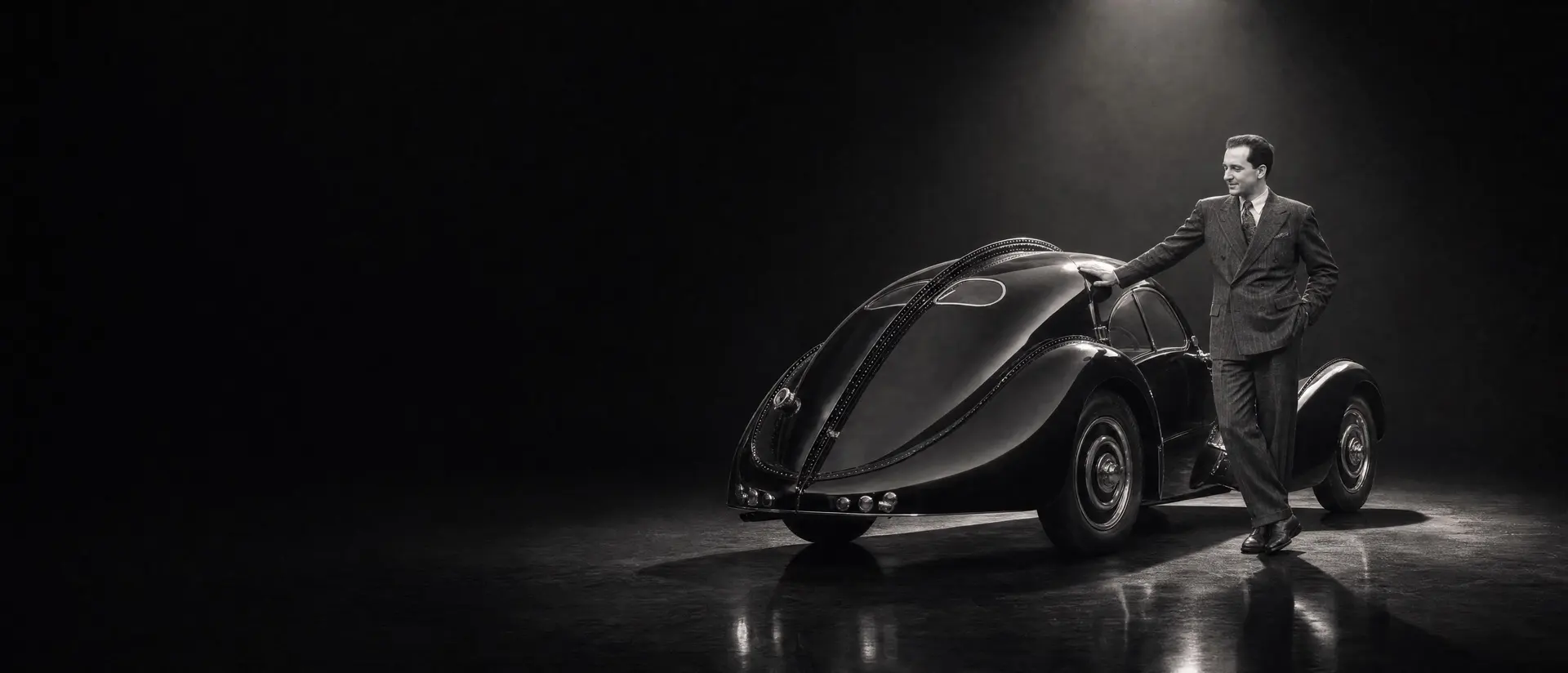
Jean Bugatti in a 1930s suit, one hand resting on the riveted dorsal seam of a Bugatti Type 57 SC Atlantic under a single spotlightAI-generated

People · Designer · 1909–1939

Jean

le fils de Molsheim

Born
Cologne, 1909
Died
Duppigheim, 1939
House
Automobiles E. Bugatti, Molsheim
In the register
Four files

Molsheim’s son

Born in Cologne in 1909, Jean Bugatti grew up inside his father’s works and was essential to the firm by the late twenties; from 1936 he ran it. His central act was the Type 57 — one adaptable base carrying every body the house could draw — the moment Molsheim became its own coachbuilder.

The files are precise about what they credit. On the Royale he is the coachwork designer, not the author of the whole car; on the Type 57 he is the programme’s lead. His vocabulary is documented — the C-line, the dropping beltline, duotone surfaces, forms drawn to catch light — and the four files below hold it.

The seam

The riveted spine

His signature line began as a materials problem. Two half-shells, one join — read it from either side.

Necessity

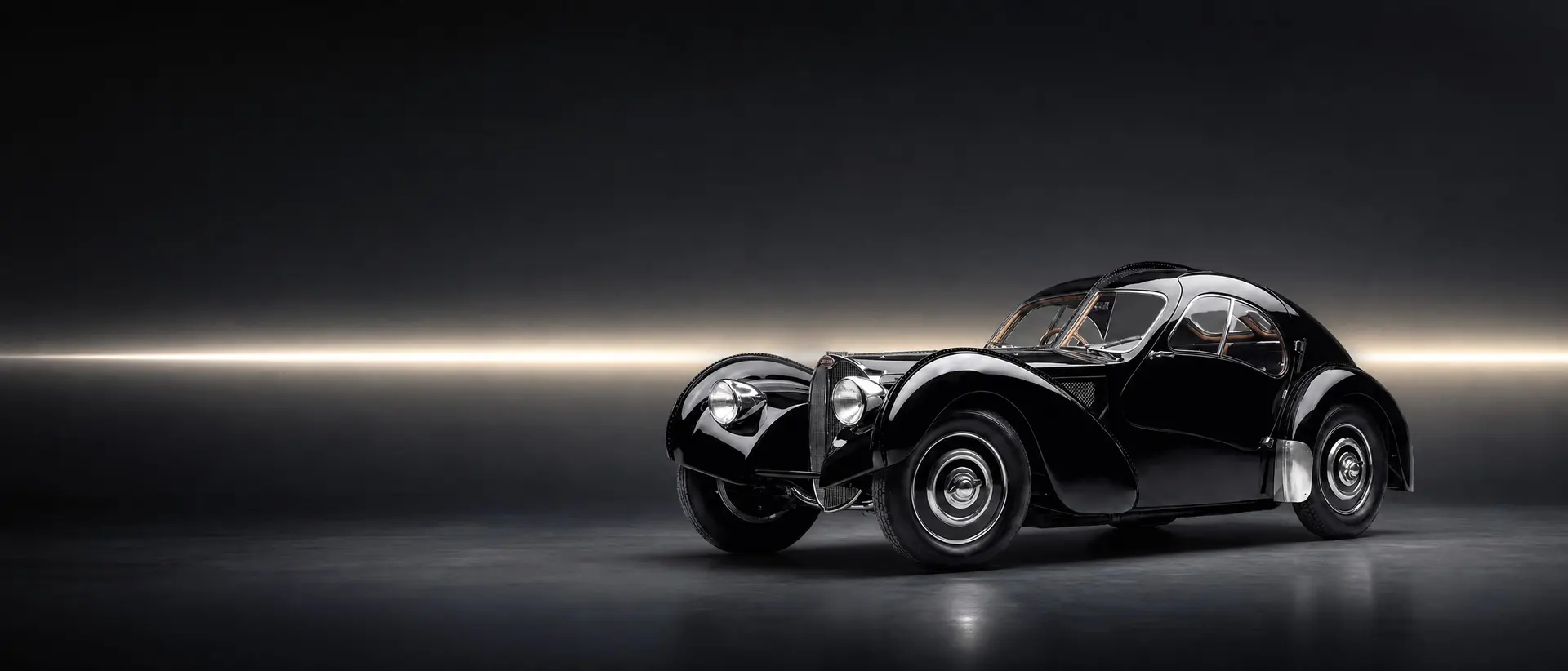
The 1935 Aérolithe was bodied in Elektron, a magnesium alloy that could not be welded. So the body was joined the only way it could be: riveted, the seam left standing proud along the spine, with the low roof and long bonnet it would hand on.

Signature

The four production Atlantics were aluminium — rivets no longer required. The seam stayed. What material necessity had forced on the prototype, Jean kept as the car’s mark: the dorsal line an Atlantic is recognised by at a glance.

The vocabulary

The base, the door, the falling line

One base, many bodies

The Type 57 was a single adaptable chassis carrying body and engine derivatives, not a family of separate model lines. The idea organised the factory’s whole touring range.

Coachwork brought home

Under Jean, Molsheim drew its own bodies. Even the Stelvio and Aravis, executed by Gangloff, were built to his plans — the factory as its own coachbuilder.

The roof-cut door

The Atlantic sat too low for an ordinary aperture, so the doors were cut up into the roof. Entry itself became part of the design.

The C-line

The C-line, the dropping beltline, duotone surfaces and forms drawn to catch light — the documented Bugatti vocabulary, his hand across the range.

The customer’s daylight

Esders never drove after dark, so his Royale roadster carried no headlamps. Jean let the client’s life edit the car.

The archive

Prints from Molsheim

The family, the factory and the cars, photographed in period — choose a print and it pushes the others aside.

Jean with the Royale Roadster Esders. Arnaud 25, CC BY-SA 4.0, via Wikimedia Commons.

Beyond the register

From the Type 40 to the Aravis

'26–'32

Type 40

The first bodywork, from 1926 — the apprenticeship served inside the factory.

Type 43 Grand Sport

Grand Sport bodywork in the late twenties.

Type 46

Body designs for the big touring chassis, early thirties.

Type 50 Coach Profilée

The profiled coach of 1932.

Type 55 Roadster

The 1932 roadster body.

'34–'40

Type 57 Galibier

The saloon of the Type 57 factory body families.

Type 57 Ventoux

The two-door of the same programme.

Type 57 Stelvio

The cabriolet — executed by Gangloff to Jean’s plans.

Type 57 Aravis

The late cabriolet — likewise Gangloff, to his drawings.

Duppigheim · 11 August 1939

A test drive near Duppigheim. He was thirty.

Jean Bugatti had led the firm since 1936. The work in the four files was already complete.

The house

Bugatti

His father’s firm at Molsheim holds Jean’s entire register. An essential part of it by the late twenties, he defined its factory coachwork through the thirties and led the company from 1936 — the son who turned a chassis-maker’s catalogue into a coachbuilder’s.

Head of the firm, 1936–1939

In his words

“I have brought a car that is unsuitable for your hill.”

Jean Bugatti · after Wimille’s run, Prescott hill climb, 1939