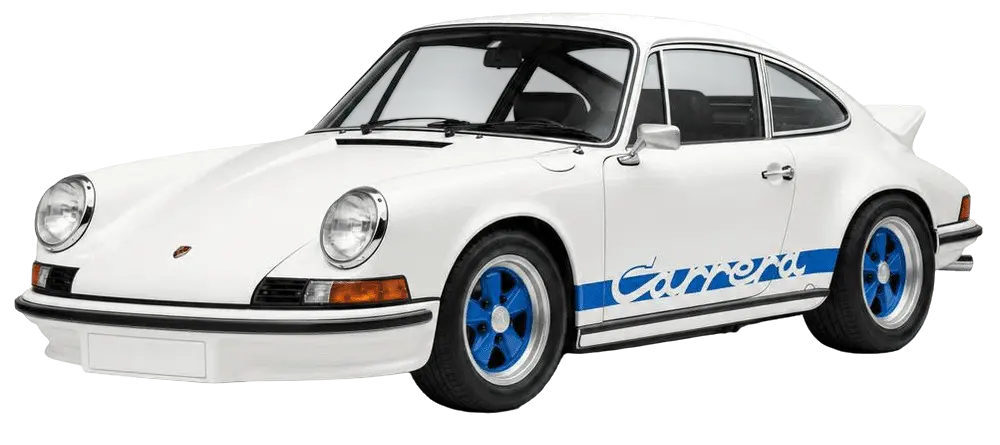
Cardboard on the lid
He later recalled that the ducktail was found by laying cardboard, sheet metal and wooden blocks on the engine cover in the FKFS tunnel, with Brodbeck and Wiener, and watching what happened.
People
Porsche aerodynamics engineer, co-developer of the Carrera RS 2.7 ducktail
The record
Porsche aerodynamics engineer who, with Tilman Brodbeck and Rolf Wiener, developed the rear spoiler of the Carrera RS 2.7, later headed body development at Weissach, and retired from Rücker AG in 2006.
Born and raised in Stuttgart on 1 October 1940, the son of a baker, Burst studied mechanical and automotive engineering at the University of Stuttgart from 1960 to 1966. He joined the FKFS in 1967 as a scientific employee at its wind tunnel, working on cars and aircraft, including helicopters. There he met Porsche racing chief Peter Falk in 1968, joining Porsche’s racing department in January 1969, aged 28.
At Porsche he improved the aerodynamics of the 917, 917 Can-Am, 908-03 and 908-02 long-tail, and handled process planning and homologation of the first 25 917s, inspected by the FIA at Plant 1 on 21 April 1969. A complete 917 went to the FKFS tunnel at Untertürkheim; he later recalled that attention had centred on drag rather than critical lift. From mid-1970 he worked at SERA in Paris on a short-tail 917 body.
From 1972 he headed bodywork testing. Helmuth Bott asked him to reduce 911 lift. With Tilman Brodbeck and stylist Rolf Wiener he developed a rear spoiler in the FKFS tunnel from cardboard, sheet metal and wooden blocks. The three filed disclosure No. 2238704 on 5 August 1972. The Carrera RS 2.7 appeared at the Paris Motor Show that October; Porsche reported 4.5 km/h more top speed without an increase in drag.
He then worked on forms that still read as a 911, producing the larger rear wing Porsche later called the whale fin, and with the front spoiler gave the 911 Turbo balanced aerodynamics. After German authorities objected to the whale tail, Porsche took the case to court and won. In 2024 he named the 964 Turbo his technical favourite.
His bodywork-testing brief covered consumption, durability, safety, climate and equipment. From 1988 he headed body development at Weissach. He left in 1992 for Rücker AG as a shareholder and Management Board member, later a Supervisory Board member, and retired in 2006. In 2026 he confirmed that the transaxle tube of the 924 and 944 had been part of the crash structure from the start.
He later recalled that the ducktail was found by laying cardboard, sheet metal and wooden blocks on the engine cover in the FKFS tunnel, with Brodbeck and Wiener, and watching what happened.
After the ducktail, Porsche says Burst continued to work on forms that matched the basic 911 body and remained recognisable as its evolution. That work led to the rear spoiler Porsche later referred to as the “whale fin”.
When German authorities refused the 911 Turbo’s whale tail as a cyclist hazard, Burst’s side crash-tested dummies and added a rubber-like edge. Porsche then sued the Federal Republic and won.
The stations
The house

Credited through Porsche.
In the register
The files above are the register's own record of this name. The people index holds everyone the register credits.
In their words
“Our goal in the 911 was always to keep rear axle lift low. We achieved this through the various spoiler configurations that have been created over many generations. This meant that the original idea of the 911 body shape, which is timeless, can still be upheld to this day.”
Hermann Burst · Porsche Newsroom, 2024
Sources