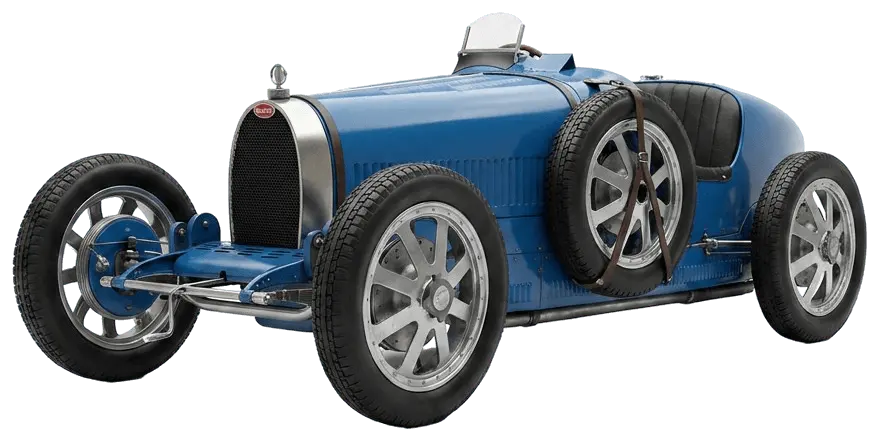
Hollow axle, alloy wheels
On the Type 35 he specified a hollow front axle with sealed ends and patented cast-aluminium wheels that carried the brake drums as one piece, so a wheel change also renewed the drum and cut unsprung mass.
People
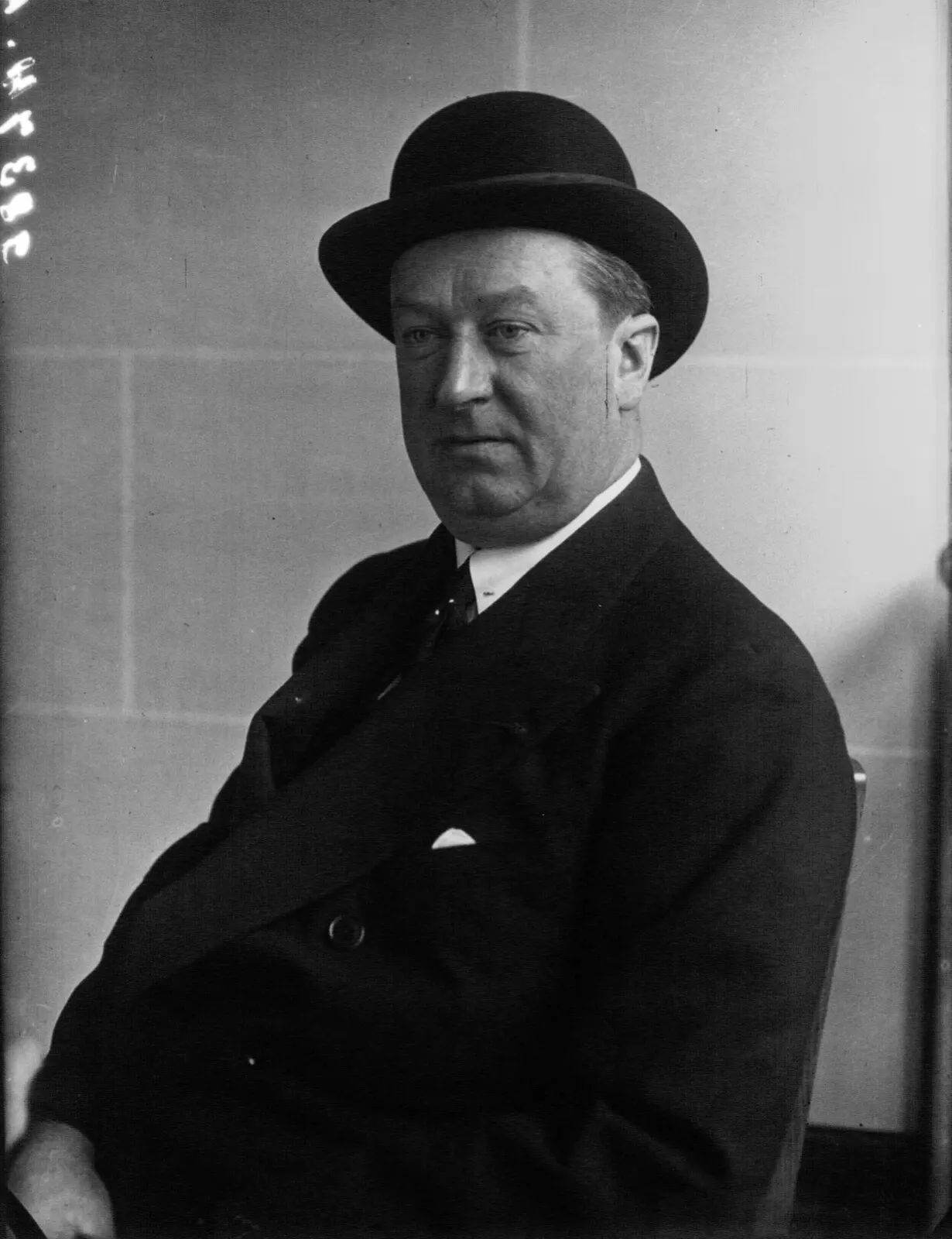
Designer, engineer and founder of Automobiles E. Bugatti
Wikimedia Commons
The record
Italian-born founder of Automobiles E. Bugatti, who designed the Type 35 and Type 41 Royale at Molsheim and remained engineering director while Jean Bugatti developed the Type 57 SC Atalante.
Born in Milan on 15 September 1881 to the furniture designer Carlo Bugatti and Teresa Lorioli, Ettore began architecture, painting and sculpture at Brera. In 1898 he entered Prinetti & Stucchi as an apprentice after testing their motor tricycle. When they refused a second car he designed one with the Gulinelli brothers; shown in Milan in 1901, it won the Gran Premio and an ACF medal and brought a licence contract from De Dietrich of Niederbronn.
Still a minor, he needed Carlo to sign the seven-year De Dietrich engagement. From 1902 he designed cars sold as De Dietrich-Bugatti; the house left automobiles in 1904. He partnered with E. Mathis on the Hermes, then in 1907 became head of production at Deutz in Cologne, reserving the right to work on his own designs. In 1909 he built a lightweight four-cylinder prototype and, with the Darmstadt Bank, established Automobiles E. Bugatti at Molsheim, delivering the first Type 13s in 1910.
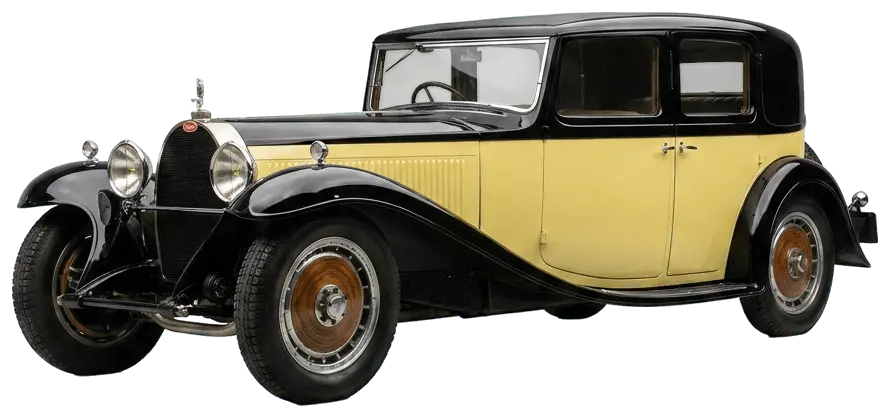
War closed Molsheim in 1914. He hid three racing engines, served from 1915 at Chalais-Meudon designing aero engines, and reopened the ruined works in January 1919. The register credits him as designer and engineer of the Type 35, whose 1924 design combined a compact straight-eight with cast-aluminium wheels and a hollow front axle. For the Type 41 Royale he directed development of a luxury car first prototyped in 1926; production cars used a 12.8-litre straight-eight. Six were built, four sold; leftover engines went into railcars.
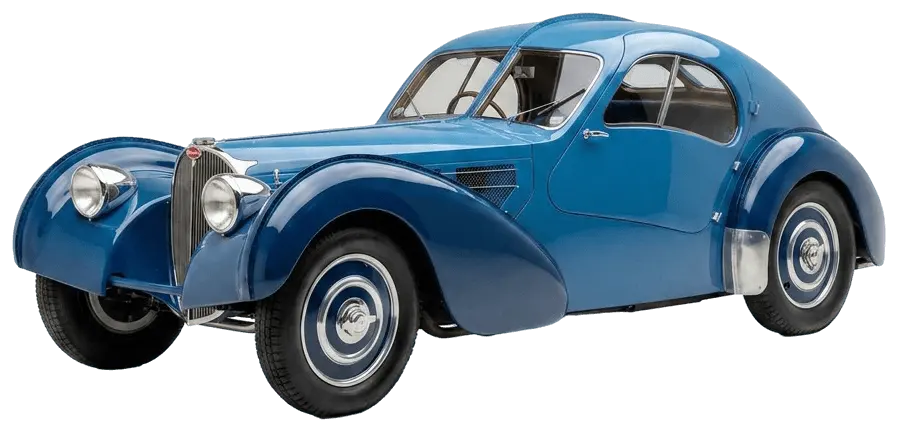
The Type 57 programme was developed by his son Jean from 1934, while the register credits Ettore as founder and engineering director for the Type 57 SC Atalante. After a 1936 factory occupation he transferred leadership to Jean, who was killed on 11 August 1939 testing a car. Ettore moved the works to Bordeaux that September; a 1941 sale and postwar confiscation ended his control. He took French citizenship in 1946, recovered the factory on appeal at Colmar on 11 June 1947, and died at Neuilly-sur-Seine on 21 August.
On the Type 35 he specified a hollow front axle with sealed ends and patented cast-aluminium wheels that carried the brake drums as one piece, so a wheel change also renewed the drum and cut unsprung mass.
For the Type 41 Royale he scaled a 1927 aircraft-engine brief into a 12.8-litre production straight-eight that made about 300 PS at 1,800 rpm, pulling a car of up to 3.5 tonnes from walking pace in top gear.
He treated mass as the enemy of speed. The Type 35 used the engine as a stressed member and an aluminium crankshaft on two roller and three ball bearings, so the eight would turn 6,000 rpm in a 750 kg car.
The stations
The house

Credited through Bugatti.
In the register
The files above are the register's own record of this name. The people index holds everyone the register credits.
In their words
“Je crois que le dessin est la base la plus solide pour réaliser toutes les idées.”
Ettore Bugatti · L'Ébé Bugatti, L'épopée Bugatti, quoted in Treccani Dizionario Biografico, 1972