People

Edmond Moglia

Italian engineer credited with Bugatti’s Type 35 three-lobe Roots supercharger

Nationality
Italian

The record

Italian engineer who worked with Ettore Bugatti on the three-lobe Roots supercharger used on experimental Type 36s in 1926 and later Type 35 variants, then co-designed the Nacional Pescara racing eight with Enrique Pateras.

An Italian engineer living in Paris, Moglia was hired in 1923 by the Egyptian prince Djelaleddin to build a racer for a land-speed-record attempt. The Djelmo combined their names and was based on a Sunbeam Grand Prix design. Its 10.1-litre twin-cam eight made 355 hp. Photographs of the seemingly complete car appeared in 1924, with Giulio Foresti selected to drive. After delays, Foresti lost control at about 150 mph on Pendine Sands on 26 November 1927. The car was destroyed and not repaired.

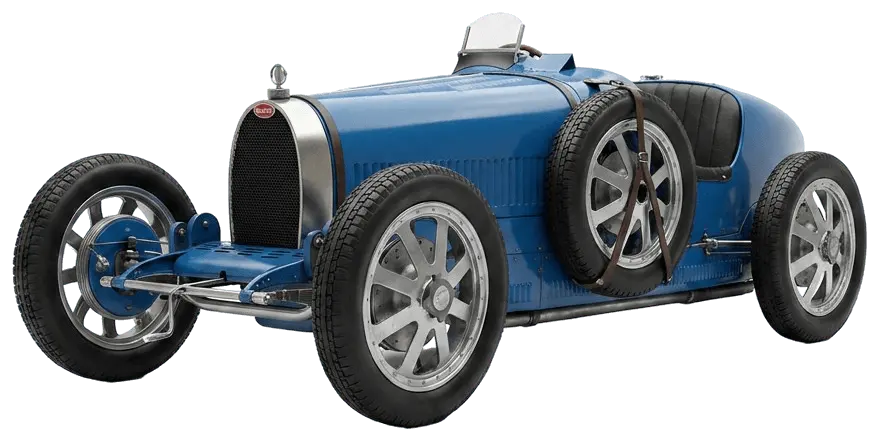
Ettore Bugatti sought French patent 576.182 for a rotary-vane compressor on 22 January 1924. He subsequently developed a Roots-type supercharger with Moglia, using three rotors rather than the usual two. Bugatti Trust research dates the factory drawings for the Moglia-designed blower to August 1925, labels them Type 39, and places it between the carburettor and engine; the carburettor remained at ambient pressure. Bugatti’s 2019 Type 35 history describes the 1926 unit as a three-lobe Roots-type supercharger.

Bugatti first introduced supercharging in its Grand Prix cars on experimental Type 36s at the Grand Prix d’Alsace on 30 May 1926. The unit was mounted on the engine’s offside, and a relief valve above the manifold discharged excess boost through an opening in the bonnet. In later Type 35 variants, the Type 35C used a Roots supercharger, while the Type 35B paired it with the 2,262 cc Type 35T engine.

In 1929 he joined Raúl Pateras Pescara, Enrique Pateras and the Spanish government in founding Fábrica Nacional de Automóviles in Barcelona. Enrique and Moglia designed the 3-litre racing straight-eight: twin overhead camshafts, a nine-bearing crankshaft and an Elektron crankcase. Unblown it gave 110 bhp at 4,800 rpm. Juan Zanelli won the 1931 European Hill Climb Championship in one. The last car was built in 1932.

Three-lobe Roots blower

Bugatti’s 2019 history identifies the 1926 unit as a three-lobe Roots-type supercharger. Factory drawings from August 1925 place the Moglia-designed blower between the carburettor and the engine, leaving the carburettor at ambient pressure.

Offside blow-off valve

The supercharger was mounted on the engine’s offside. A pressure-relief valve above the manifold vented excess boost through an opening cut in the bonnet. Those Type 36s were the first supercharged Bugattis.

Twin-cam racing eight

On the Nacional Pescara 3-litre, Moglia and Enrique Pateras specified twin overhead camshafts, hemispherical chambers and an Elektron crankcase. Unblown the racing engine made 110 bhp at 4,800 rpm; one later car ran a Roots blower at about 180 bhp.

The stations

  1. 1923–1927Djelmo (Prince Djelaleddin)Engineer hired to build a racer based on a Sunbeam design
  2. 1925–1926Independent practiceSupercharger designer with Ettore Bugatti
  3. 1928Omega-SixEngineer who revised the two-litre engine and chassis
  4. 1929–1932Fábrica Nacional de AutomóvilesTechnical engineer; co-designer with Enrique Pateras of the 3-litre racing eight

The house

Bugatti

Credited through Bugatti.

In the register

One file carries this name

The files above are the register's own record of this name. The people index holds everyone the register credits.