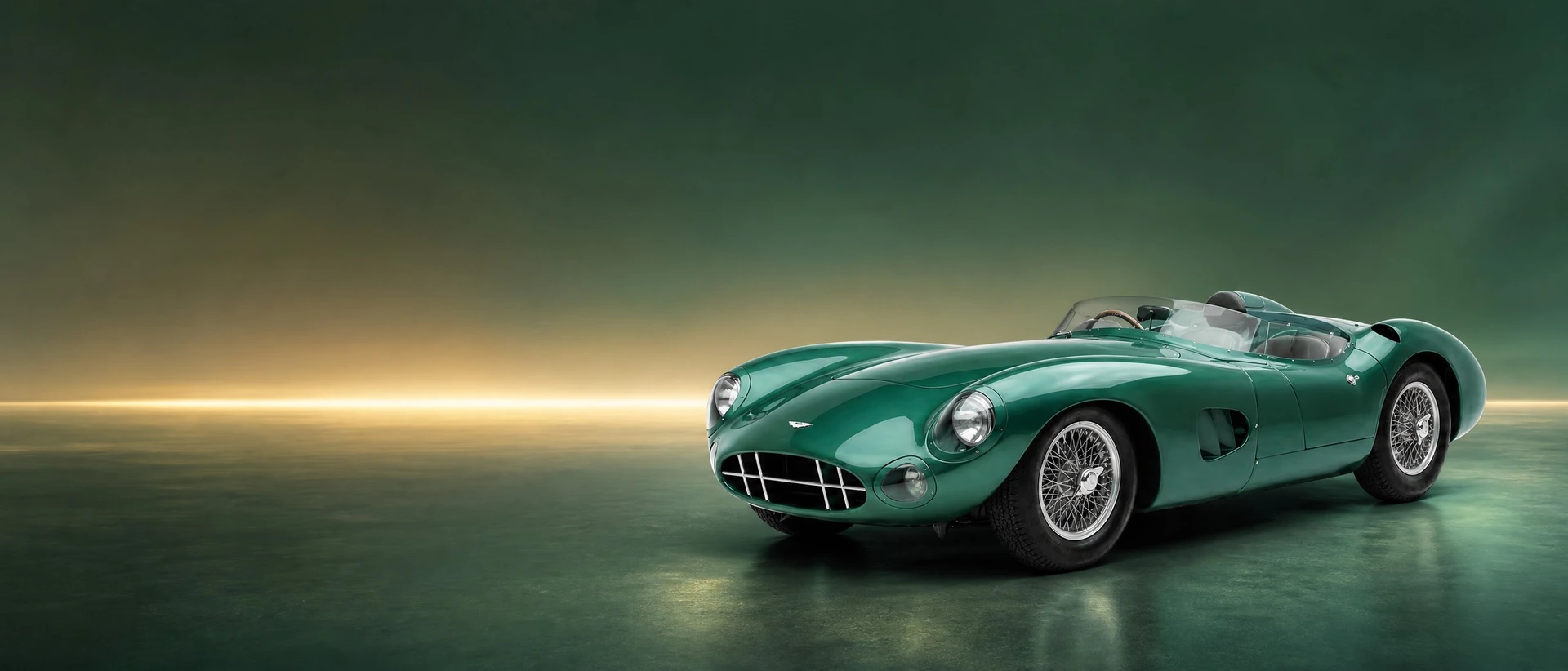
DBR1

Le Mans, then the title

Five DBR1s carried Aston Martin's works sports-racing programme. One won Le Mans outright in 1959, when the team took the World Sportscar Championship. Each chassis is judged by works results, retained components and later race history.

Market value · road

$20M$26M

Typical $23M · 0 sales

$17M$28M
Open Market & Price

Market value · road

$20M$26M

Typical $23M · 0 sales

$17M$28M
Market history builds with the record
Open Market & Price
Engine
2'992 cc (RB6 twin-plug straight-six · 1959)
Power
Up to 268 bhp (1959 works tune)
Transmission
5-speed (CG537 rear transaxle)
Chassis
Spaceframe (small-tube perimeter layout)
Built
5 (1956 to 1959)
Le Mans
1st and 2nd (1959)

Market & Price

The price and the proof

A terminal for one car: the model curve over the documented record, the benchmarks it is measured against, and the instruments that read it.

Records: 2 documented road sales on file · 2017–2017; estimate band $20M–$26M · good road cars. recorded sale prices · mixed hammer and premium-inclusive basis.

HCN:DBR1Live model
$22'803'5098.4% · 12M
$20M$40M$60M20192021202320242026CovidRate shockS&P 500
Model curve · anchored to 2 documented salesnot investment advice
The readouts · model figures against the benchmarks2 documented anchors · last sale 107 mo ago

Compound annual growth

WindowThis car*S&P 500Gold
1Y+8.4%+18.8%+21.9%
5Y-0.4%+11.4%+17.6%

*Modeled price CAGR · S&P is a price index, no dividends

Deepest drawdown · model window

This car*-18.9%Feb 2020Apr 2023 · not recovered
S&P 500-20.3%Dec 2021Oct 2022 · recovered Dec 2023
Gold-18.9%Feb 2026Jul 2026 · not recovered

Forecast ladder · model quantiles

HorizonP10P50P90
+6M$21M$23M$25M
+12M$21M$23M$26M
+24M$21M$24M$28M

Median path with the 10th and 90th percentile · not investment advice

Transaction ledger · documented sales

2 of 2 recorded sales · shown in USD · recorded currency in each record

Price range · road · openConfidence · lowOnly one modern public auction result is available for a five-car population. Chassis-specific competition history, retained original components and eligibility for major historic events can outweigh the model-level band.

Floor

$20M

Typical

$23M

Ceiling

$26M

Estimate band for good road cars. 0 documented sales since 2019 plotted below.

$16M$20M$23M$26M$28M
Hover the spectrum to read a value, or a dot for the sale behind it.

Band, axis and sale positions shown in recorded USD. Indicative USD range anchored to DBR1/1's documented 2017 result; it is not a statistical market.

The wider market · Aston Martin at auction · median per year · modeled between anchors1,805 lots · 2003–2026 · exact yearly anchors · modeled line

Instrument calibration for this file is in progress — the terminal above reads the documented record directly.

The ledger records a public auction result only. Private transfers among the other four chassis are not inferred.

Overview

A purpose-built answer to new prototype rules

Aston Martin began the DBR1 after the 1955 Le Mans race, moving away from production-based machinery. Ted Cutting drew the small-tube chassis, torsion-bar suspension and aluminium body around a new racing straight-six.

The single 1956 Le Mans entry retired after 20 hours. Wins arrived in 1957 at Spa and the Nürburgring; by 1959 the team had built five cars and resolved enough of the engine and transaxle weaknesses to mount a full title campaign.

Roy Salvadori and Carroll Shelby won the 1959 24 Hours in DBR1/2, with Maurice Trintignant and Paul Frère second in DBR1/4. Aston Martin also won the World Sportscar Championship before withdrawing its works team at the end of the season.

Built
5
Designer
Ted Cutting
Works engine
RB6 straight-six
Le Mans
Winner · 1959
Championship
World Sportscar · 1959

Reference

Technical specifications

Powertrain

Engine
RB6 all-aluminium straight-six2'493 cc in 1956; 2'922 cc and finally 2'992 cc
Cylinder head
Twin-plug DOHC95-degree head and triple Weber 50 DCO carburettors by 1959
Power
Up to 268 bhp1959 works configuration; earlier engines produced less
Gearbox
CG537 5-speed transaxlerear-mounted, semi-dry-sump unit

Chassis

Structure
Small-tube perimeter spaceframedesigned under Ted Cutting
Body
Thin-gauge aluminiumCutting also shaped the works body
Front suspension
Transverse torsion bars
Rear suspension
De Dion with longitudinal torsion barstrailing links and Watt linkage
Brakes
Girling discslight-alloy calipers

HICON BID

Buying interest, silently.

A HICON Bid is a confidential expression of buying interest on the Aston Martin DBR1 file — never public, never shown to other members. It is not a binding purchase, and HICONIUM holds no funds.

Sign in

HICON Bids are a member instrument. Sign in to place one.

The vault

Open a file on yours.

You keep one? The record starts in your garage — identity, papers, photography, and the market evidence this file already carries, bound to your chassis.

The hands

The people behind the car

The people whose work shaped the Aston Martin DBR1.

No free period portrait on record

Ted Cutting

Race car design chief

Designed the DBR1's spaceframe, suspension package and aluminium body, then led its mechanical development through the three-litre programme.