A brief, then room
Jack Phillips recalled Grylls's 1954 request for roughly fifty per cent more power and torque within the existing bonnet. Phillips described him as a boss who gave broad-brush requirements and left the design to the designers.
People
Chief Engineer, Rolls-Royce Motor Car Division
The record
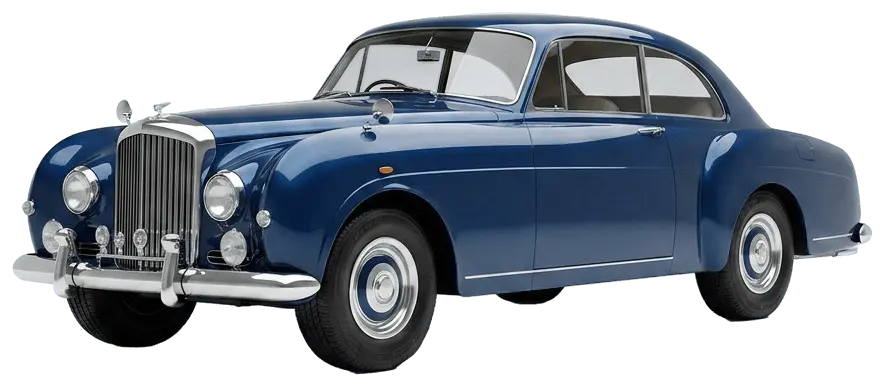
A Rolls-Royce Motor Car Division chief engineer, Grylls gave lead engine designer Jack Phillips the brief for the L-series V8, which debuted in the 1959 Bentley S2, and later led engineering of the monocoque Silver Shadow.
Shadwell Harry Grylls was born at St Neot, Cornwall, in July 1909. The 1959 Who's Who in the Motor Industry records Rugby and Trinity College, Cambridge, and says he was first connected with the motor industry in 1930. Motor Sport's obituary says he joined Rolls-Royce at Derby that year after employment in the experimental shops, becoming personal assistant to the Works Director.
He moved to the new Crewe factory in 1948 as Assistant Chief Engineer. The contemporary directories do not give an entirely clean title chronology. The 1953 Who's Who records Grylls as Chief Development Engineer in the Motor Car Division, appointed in 1951; the 1959 edition calls him Chief Engineer since 1951. Motor Sport's obituary dates that promotion to 1957. A 1965 Hansard list identifies S. H. Grylls as Chief Engineer, Rolls-Royce Ltd.
Ludvigsen's account places Grylls at the start of the V8 programme: in early 1954 he asked Jack Phillips for a unit that would fit the existing bonnet, make roughly 50 per cent more power and torque, weigh no more than the six, use the same radiator area and cost no more. Phillips was lead engine designer. Grylls rejected a longer straight-eight and later ordered the first wide heads narrowed. The production L410 had 6,230 cc.
Bentley says Grylls led the team responsible for the L-series engine, which debuted in the 1959 S2; it reports more than 36,000 units by its 2020 withdrawal. He then led engineering of the monocoque Silver Shadow, announced in 1965. Independent rear suspension, tried on Mark VI and S1 Bentleys, followed a small Renault; the hydraulics were a modified Citroën system made under licence.
He chaired the Institution of Mechanical Engineers Automobile Division in 1963–64. Motor Sport recorded him as Technical Director by 1968. The 1970 New Year Honours named Grylls CBE, lately Technical Director of the Motor Car Division, for services to export. He died at his Pershore home in late October 1983, aged 74.
Jack Phillips recalled Grylls's 1954 request for roughly fifty per cent more power and torque within the existing bonnet. Phillips described him as a boss who gave broad-brush requirements and left the design to the designers.
In his 1963 Institution of Mechanical Engineers address as incoming Automobile Division chairman, Grylls traced forty-four years of Rolls-Royce car-engine development through a 4.150-inch centre distance between neighbouring cylinder bores, unchanged since 1919.
Grylls refused a straight-eight for the 1959 S2 because it would have lengthened the bonnet. He argued that the difficulty of making a car free from 'jellying' varied with the cube of the distance from the driver to the front wheels.
The stations
The house

Credited through Rolls-Royce and Bentley.
In the register
The files above are the register's own record of this name. The people index holds everyone the register credits.
In their words
“No automotive engine ever gives enough power.”
Harry Grylls · S. H. Grylls, “The History of a Dimension,” Proceedings of the Institution of Mechanical Engineers, Automobile Division, vol. 178 (1963), pp. 1–19.
Sources