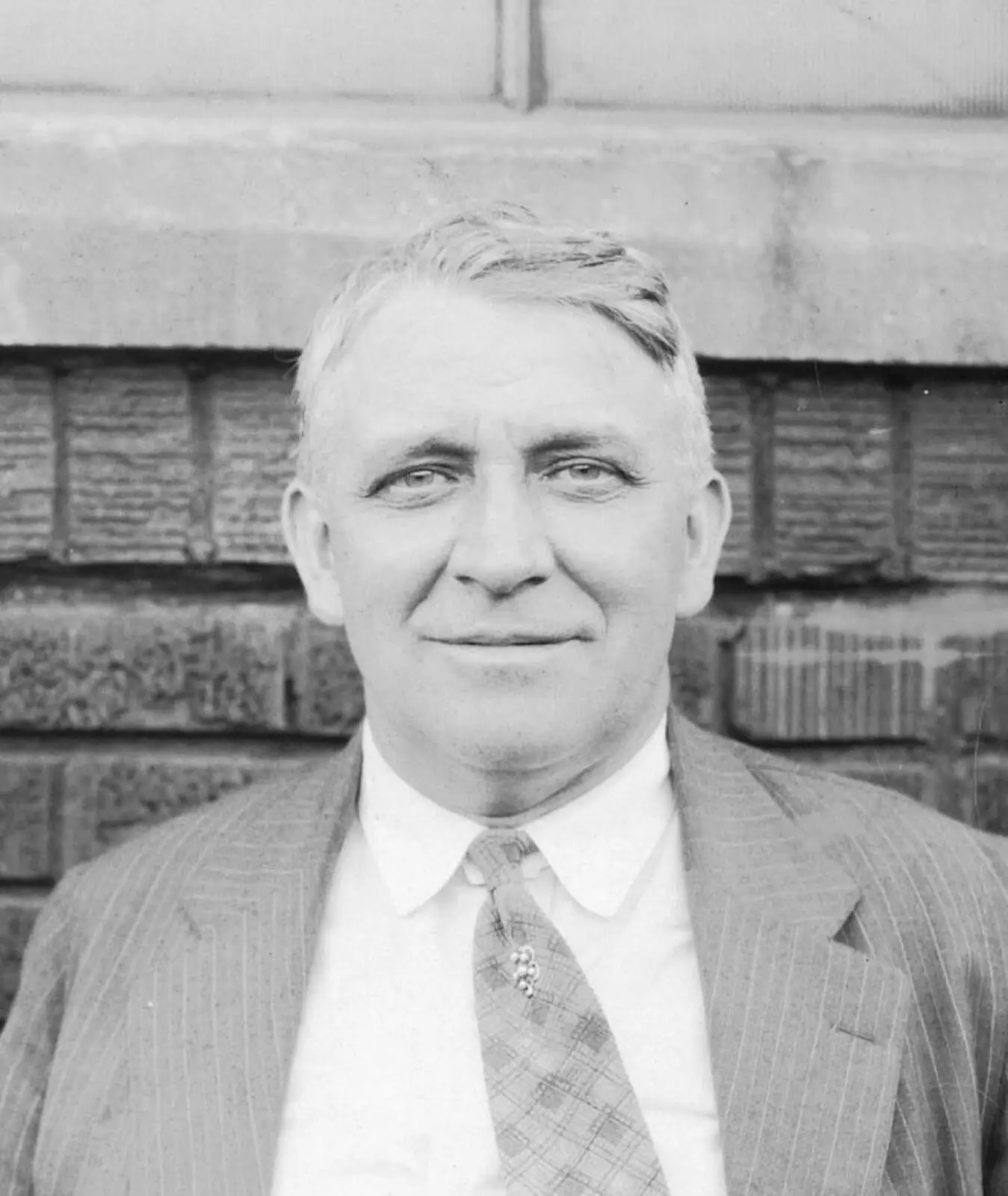
Portrait photograph of Fred Duesenberg.

People

Fred Duesenberg

Duesenberg engineer and Model J designer

Born
Kirchheide, Lippe, 1876
Died
Johnstown, Pennsylvania, 1932
Nationality
German-born

Wikimedia Commons

The record

German-born engineer who designed the Duesenberg Model J after E. L. Cord acquired the company in 1926. He had already put a production straight-eight and four-wheel hydraulic brakes on the Model A.

Born Friedrich Samuel Duesenberg in Kirchheide, Lippe, on 6 December 1876, he emigrated with his family to Iowa in 1885 after his father's death. He left school after the eighth grade, repaired farm implements at seventeen, then opened a bicycle shop in Rockford and raced. In 1903 he worked about a year at Thomas B. Jeffery & Co. in Kenosha on the Rambler.

In Des Moines he worked with August and lawyer Edward R. Mason on a two-cylinder car after a mechanical-drawing course at the International Correspondence Schools of Scranton. The first Mason appeared on 19 February 1906. Maytag took a controlling interest in 1910; the brothers moved to St Paul in 1913.

At St Paul, the brothers founded Duesenberg Motor Company and built racing and marine engines. In 1917 its merger with Loew-Victor made Fred chief engineer. Three years later they formed Duesenberg Automobile and Motors Company in Indianapolis. Its racing cars won the 1921 French Grand Prix with Jimmy Murphy and took the Indianapolis 500 in 1924, 1925 and 1927. The Model A used a straight-eight engine and four-wheel hydraulic brakes.

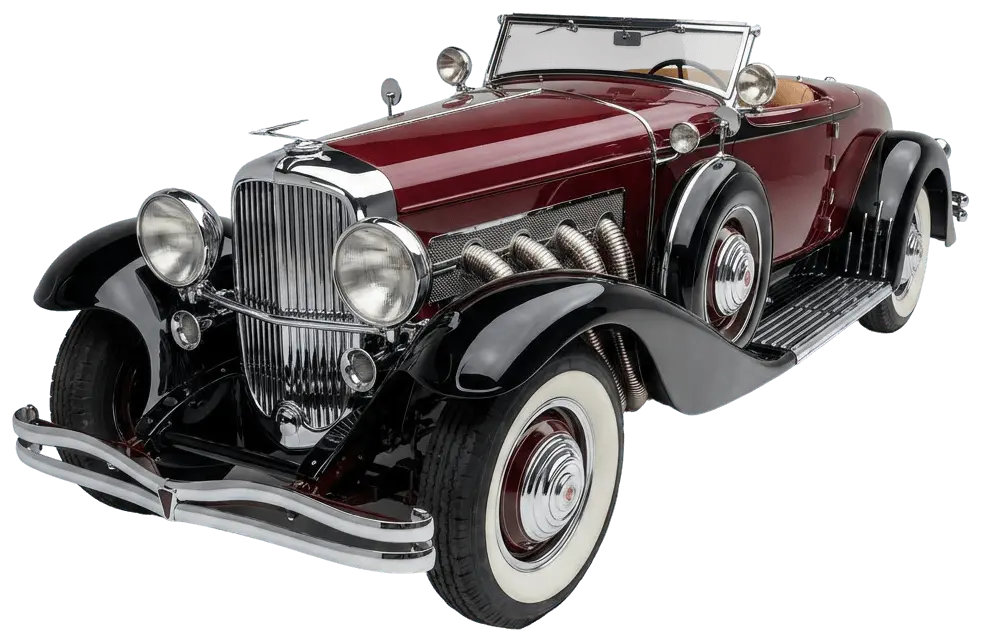
E. L. Cord bought Duesenberg Automobile and Motors Company in October 1926 and retained Fred as a consulting engineer; he later became vice-president in charge of engineering. Fred designed the Model J, introduced in New York in December 1928 and placed in production in 1929. Lycoming built the twin-overhead-cam straight-eight; coachbuilders supplied the body.

A supercharged SJ appeared in May 1932. On 2 July he lost control of a Duesenberg on Ligonier Mountain, about two miles west of Jennerstown, Pennsylvania. He suffered broken ribs and a spinal injury. In hospital in Johnstown he developed pneumonia and died of a heart attack on 26 July 1932.

Twin-cam road engine

The Model J used a dual-overhead-cam straight-eight with four valves per cylinder, 420 cubic inches, rated at 265 bhp. Fred designed it in Indianapolis; Lycoming built it. The factory sold a chassis; coachbuilders supplied the body.

Hydraulic four-wheel brakes

The Model A introduced four-wheel hydraulic brakes in 1921, the first on an American production car. Fred filed the patents on 16 November 1920. Model J chassis kept hydraulic drums on all four wheels.

Racing as development

Duesenberg used racing to prove speed and durability. Jimmy Murphy won the 1921 French Grand Prix in a Duesenberg; the cars won Indianapolis in 1924, 1925 and 1927. After Cord bought the firm, Fred concentrated on passenger cars while Augie ran the racing side.

The stations

  1. 1894–1897Farm implement dealer, Rockford, IowaMechanic
  2. 1897–1903Bicycle shop, Rockford, IowaProprietor and racer
  3. 1903–1904Thomas B. Jeffery & Co., KenoshaMachinist, Rambler works
  4. 1904–1905Des Moines garage / Prouty partnershipMachinist; Rambler and Marion agent
  5. 1905–1910Mason Motor Company / Maytag-Mason Motor CompanyEngineer
  6. 1910–1913Independent / Mason Motor CompanyRacing-engine designer
  7. 1913–1917Duesenberg Motor CompanyCo-founder and engineer
  8. 1917–1920Duesenberg Motor CorporationChief engineer
  9. 1920–1926Duesenberg Automobile and Motors CompanyManager and chief engineer; later president
  10. 1926–1932Duesenberg, Inc.Consulting engineer; later vice-president of engineering

The house

Duesenberg

Credited through Duesenberg.

In their words

Well, people that worry about getting credit, never get anything done.

Fred Duesenberg · Gordon Buehrig, oral history with David R. Crippen, July 1984, Benson Ford Research Center, The Henry Ford